
Chief Executive Officer Armin Papperger said the increase was necessary to sustain the pace of production. Rheinmetall’s backlog reached €80.4 billion after new nominations rose 476% to €11.37 billion.
“We need these goods in our stocks, otherwise it’s impossible to grow,” Papperger told analysts during Rheinmetall’s second-quarter 2026 earnings call. The company is waiting for advance payments from major contracts to offset part of the working-capital burden.
Rheinmetall expects a payment from Romania and another from Germany if it books the Arminius contract. Papperger described Arminius as “the big elephant in the room” but provided no payment value or timetable.
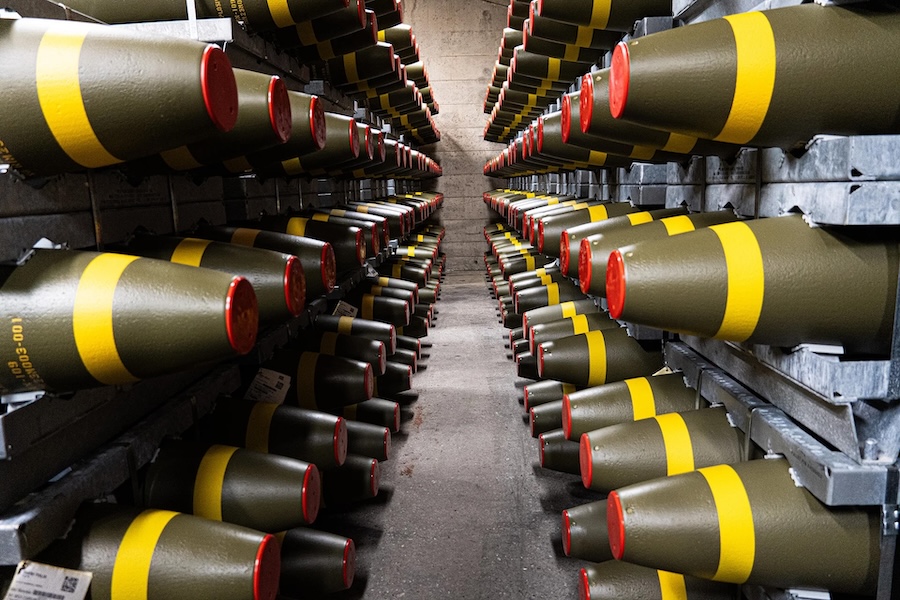
The inventory build-up forms part of a broader industrial expansion across ammunition, explosives, propellants and missile components. Rheinmetall is seeking to align material availability with new production capacity scheduled to enter service through 2027.
An RDX plant in Várpalota is expected to be completed in 2027. The group is also adding powder-blending capacity in Switzerland.
Rheinmetall plans to start production at a new powder plant in Aschau during the third quarter of 2027. Papperger said the facility would have capacity for up to 4,500 tons of triple-base powder.
The company is also expanding rocket manufacturing. It has a rocket plant in Burgos and expects a rocket-motor facility in Unterlüß to be ready in the first quarter of 2027.
Management is reducing projected capital expenditure through purchasing savings and synergies. Papperger said those savings would not delay factories or reduce planned output.
“We reduce CapEx at the moment, not because we reduce the factories,” Papperger said. “The capacities of our production lines are absolutely in line what we planned.”
Rheinmetall expects capital expenditure to equal about 8% to 9% of sales in 2026. The company is seeking to lower the cost of adding capacity rather than narrow the expansion program.
The ramp-up is already feeding into revenue and earnings. Second-quarter sales rose almost 70% to €3.29 billion, while the operating result more than doubled to €562 million.
First-half revenue increased 39% to €5.5 billion. Papperger said the performance remained in line with Rheinmetall’s full-year guidance.
Rheinmetall is also hiring about 10,000 employees a year to support the expansion. The company received more than 160,000 job applications, giving it a large recruitment pool.
The near-term cost of the ramp-up is most visible in cash flow. Management expects advance payments and higher production volumes to improve cash conversion as new contracts move into execution.