
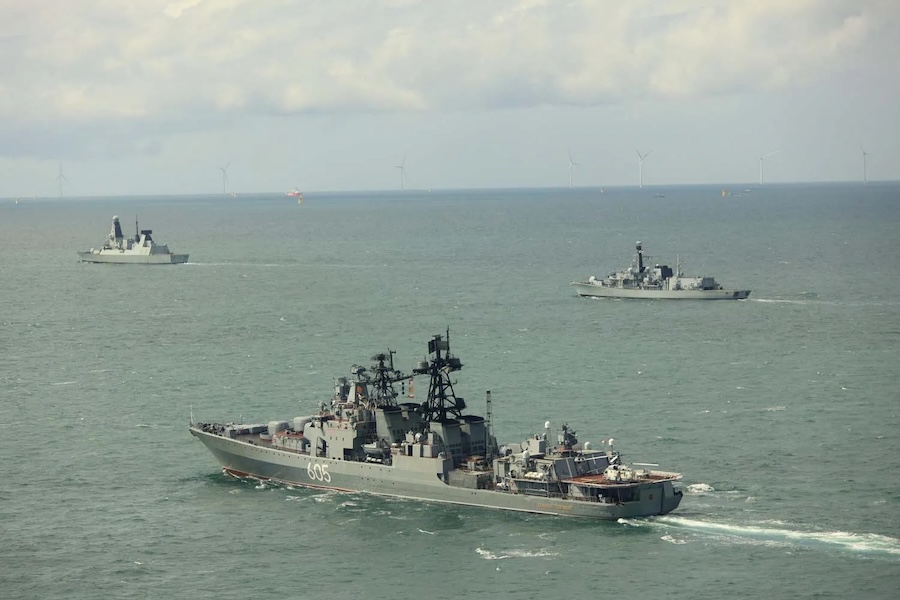
The Royal Navy announced on 29 August that HMS Duncan, HMS St Albans and HMS Severn had tracked the Russian destroyer Admiral Levchenko as it escorted the sanctioned cargo vessels General Skobelev and Sparta south through the North Sea. The group was monitored into the English Channel using the British ships’ radars and other sensors.
The Royal Navy said Russia also deployed the frigate Neustrashimy to protect the cargo vessels. British monitoring continued through the Channel before responsibility was transferred to a NATO ally near Ushant off the French coast.
A Merlin helicopter launched from HMS St Albans extended surveillance as the vessels approached the Strait of Dover. HMS Mersey conducted a separate operation nearby to shadow the Russian replenishment ship Akademik Pashin.
The latest deployments follow Britain’s interdiction of the sanctioned shadow-fleet oil tanker Smyrtos in the English Channel in June. “The interception of the Smyrtos was a clear demonstration that the UK and Royal Navy will act against those who seek to evade sanctions to fund Russia’s egregious war on Ukraine,” said General Sir Gwyn Jenkins, the First Sea Lord and Chief of Naval Staff.
Jenkins said subsequent route changes had imposed additional costs and delays on Russian shadow-fleet vessels, while forcing Moscow to divert warships to escort duties. “Shadow fleet vessels continue to pose an unacceptable risk to maritime security and the environment, wherever they sail.”
The UK has sanctioned more than 500 vessels as part of its efforts to restrict Russian energy revenue. Russia’s oil and gas revenue fell 24% year on year in 2025, according to the Royal Navy statement.
“As part of the UK’s response to increased Russian activity within UK waters, St Albans was part of a group of NATO warships and aircraft escorting Russian warships and merchant vessels through the North Sea and English Channel, monitoring their activity,” said Commander Oli Ayers, commanding officer of HMS St Albans. “We will continue these sorts of operations, working alongside NATO allies, over the next few months.”
HMS Duncan sailed to Copenhagen after the operation for an engagement focused on defence ties between Britain and Denmark. The destroyer had recently returned from operations in the North Atlantic and High North with the UK Carrier Strike Group.
The deployment was HMS Severn’s third mission to monitor Russian movements during the month. Earlier assignments included tracking Neustrashimy and operating with HMS Tyne to monitor the frigate Admiral Gorshkov, the survey vessel Romuald Muklevich and Akademik Pashin.