
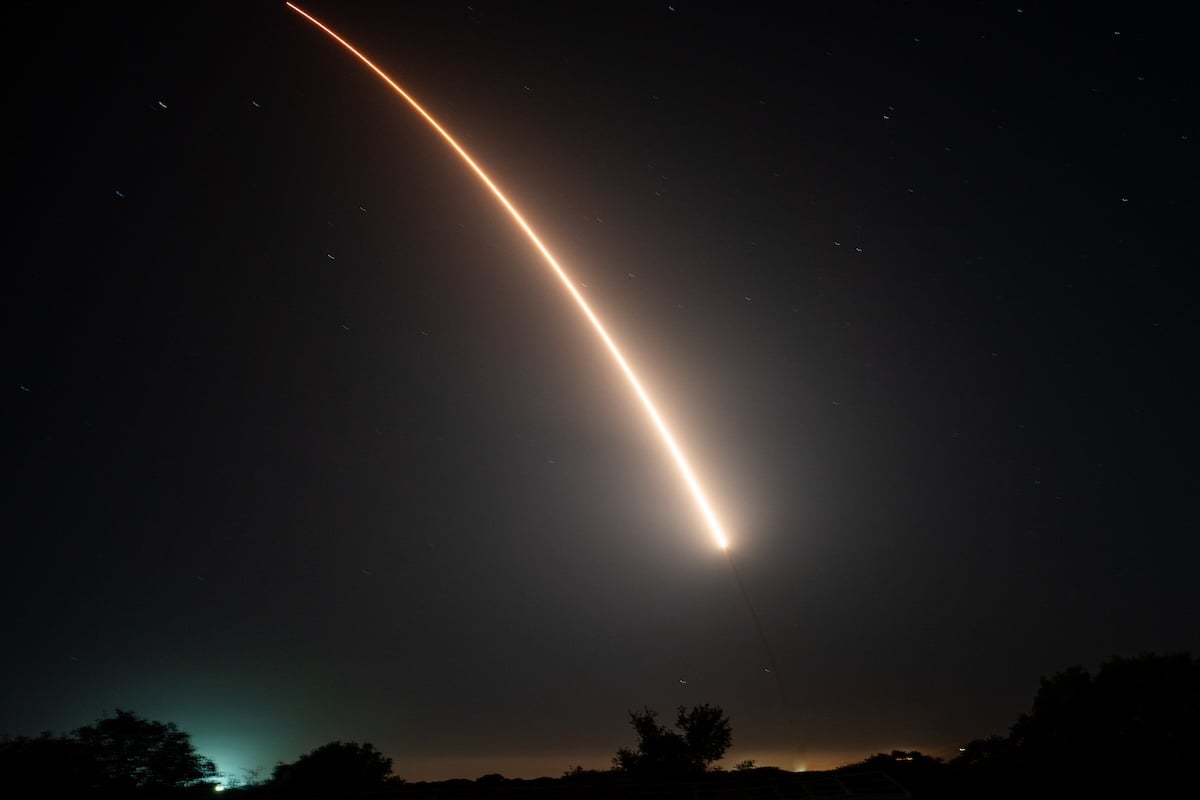
Lockheed Martin is producing the Mk21A, which is now in its engineering and manufacturing development phase. The Air Force said the vehicle will be integrated on a future ICBM once it reaches full operational capability.
“The Mk21A is crucial to modernizing our ICBMs in response to the rapidly changing global threat picture posed by our adversaries,” said Maj. Gen. William Rogers, Air Force portfolio acquisition executive for ICBMs and director of ICBM systems at the Air Force Nuclear Weapons Center (AFNWC). “The reentry vehicle’s development will ensure a safe, secure and effective deterrent for generations to come.”
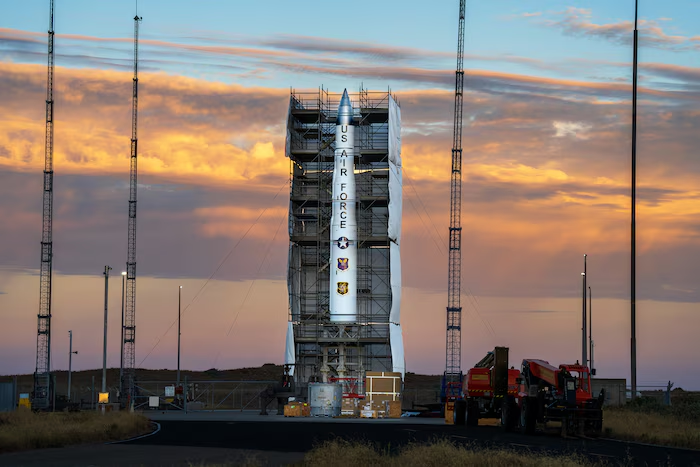
The launch follows a flight test in the Pacific Ocean in June 2024 and a failed first attempt in July 2022, when the rocket carrying the vehicle exploded seconds after liftoff. It also comes as the Air Force moves to replace its Minuteman III missiles with the LGM-35A Sentinel.
The Minotaur I that carried the test unit came from Northrop Grumman, which also manufactures Sentinel. The U.S. Space Force’s Rocket Systems Launch Program oversaw the launch, and the Air Force said Minotaur rockets are used to test and demonstrate new payload technologies in operationally realistic environments.
The effort to acquire the Mk21A is led by the AFNWC, which synchronizes all aspects of nuclear materiel management for Air Force Materiel Command in direct support of Air Force Global Strike Command. “Investment in modernization of the ICBM mission remains a top priority for the Air Force,” said Brig. Gen. Amanda Okeson, program manager, AFNWC ICBM Systems Directorate.
A reentry vehicle is the cone-shaped component that houses a missile’s nuclear warhead. It has to travel at high speed, withstand heat and be guided by electronics to deliver its payload accurately, according to Lockheed Martin.
The company bills the Mk21A as a next-generation integrated reentry vehicle engineered to deploy the W87-1 warhead aboard Sentinel. It says it adapted the design from the Mk21 and used digital engineering tools, including advanced modeling and simulation, to mature it.
Sentinel is expected to enter service with existing Mk21 vehicles and W87-0 warheads, switching later to the Mk21A and the modernized W87-1. Plans reported in 2023 called for the Air Force to buy 642 of the missiles, fielding 400 as one-for-one replacements for Minuteman III and keeping the rest for testing and as an operational reserve.
Lockheed Martin has been working on the vehicle since October 2019, when it won a $108.3 million Air Force contract for technology maturation and risk reduction. A $996 million contract to develop and produce the Mk21A followed on Oct. 30, 2023.
The program stumbled early. A first test planned for July 6, 2022, at Vandenberg failed when the Minotaur II+ rocket carrying the vehicle exploded 11 seconds after liftoff, contributing to a delay that had grown to about 10 months by mid-2023.
The Air Force and Lockheed Martin flew an unarmed, developmental Mk21A in a planned test in the Pacific Ocean on June 17, 2024. Lockheed Martin said at the time that the data gathered would feed into the design and future flight tests, and that the program was on schedule.
The Mk21A is not meant to be the Air Force’s final answer. In April 2023, the service issued a request for information on a Next Generation Reentry Vehicle that would eventually replace both the Mk21 and the Mk21A, but did not disclose further details.