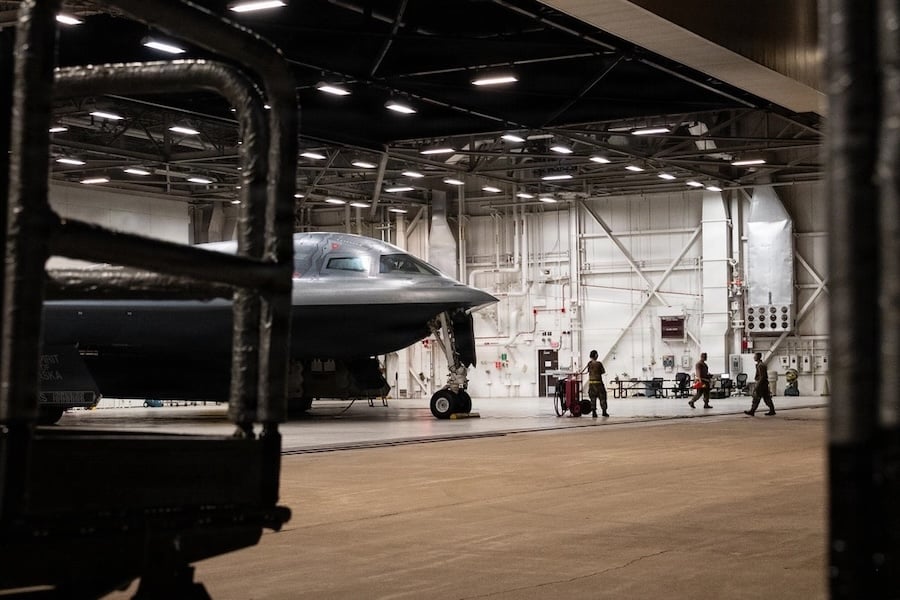
Air Force, mobility and aerospace industry leaders examined lessons from the two operations during a Sept. 15 panel at the Air, Space and Cyber Conference in Oxon Hill, Maryland. The discussion focused on the future of penetrating strike, bomber modernization, battle networks and the industrial capacity needed to sustain the force.
“We are a ready force that demonstrated our endurance,” said Maj. Gen. Ty Neuman, commander of Eighth Air Force and the Joint-Global Strike Operations Center. He said Eighth Air Force’s continuous readiness allowed it to provide tailored deterrence and reassurance around the world.
The scale of Epic Fury required close coordination across the joint force and between operational commands. Neuman said “everyone has been all in” and argued that the two operations showed the United States could hold targets at risk anytime and anywhere.
The missions also reinforced the limits of relying exclusively on weapons launched from outside an adversary’s defenses. Potential opponents are hardening facilities, burying critical infrastructure and building heavily defended anti-access zones, increasing the need for aircraft that can penetrate contested airspace.
“Not every target can be hit by long-range standoff weapons; we need a penetrating force,” Neuman said. “Modernizing the legacy bomber fleet is an imperative to denying sanctuary to our adversaries.”
The Air Force is pursuing a mix of standoff weapons and stand-in capabilities rather than treating them as competing approaches. Its current work includes expanding Beyond Line-of-Sight communications on the B-1, improving the B-2’s radar capabilities and examining additional payload options for the stealth bomber.
Stealth remains a basic requirement for aircraft and weapons expected to operate against advanced air defense systems. “All-aspect low observable weapon systems are a non-negotiable price to entry,” Neuman said.
Neuman described low observability as a lasting requirement for future combat rather than a temporary stage in aircraft design. He said the service needed both low-observable platforms and complementary low-observable munitions to survive and deliver effects inside contested airspace.
The panel also examined how commanders handle growing volumes of information from space, cyber and airborne systems. Integrated command, control and communications networks must convert that data into a coherent operational picture quickly enough to influence combat decisions.
“One can drown in data and starve for information,” said Jamie Burgess of Boeing. He said aircrews and operational commanders needed processed, actionable intelligence rather than larger quantities of raw data.
Epic Fury also demonstrated the dependence of long-range bomber operations on aerial refueling. An Air Mobility Command panelist said the mission required “dozens and dozens of tankers,” highlighting the operational link between Air Force Global Strike Command and Air Mobility Command.
The age of the bomber inventory adds urgency to the modernization effort. “Our youngest bomber is 30-plus years old,” Neuman said.
The service is investing in digital avionics, resilient beyond-line-of-sight connectivity and modern propulsion across its bomber platforms. Neuman also called for future weapons to be designed around existing bomber bays and pylons instead of requiring costly aircraft modifications for every new munition.
“Bombers must deliver strategic options to the President,” Neuman said. He said modernization was needed to preserve flexible and credible conventional and nuclear response options for the commander-in-chief.
Keeping older bombers operational also depends on cooperation with manufacturers and reliable access to critical components. “It is about partnerships, clear and concise requirements, and giving industry the ability to run with it. It’s a team effort,” Neuman said.
The panel concluded that long-range strike is a Total Force mission involving active-duty, Guard and Reserve personnel, as well as allies and partners. “This is a Total Force Integration effort for every single component,” Neuman said.
“Allies and partners, we have your back,” Neuman said. “We are the free world’s only long-range strike capability, and we will continue to deliver anytime, anywhere.”