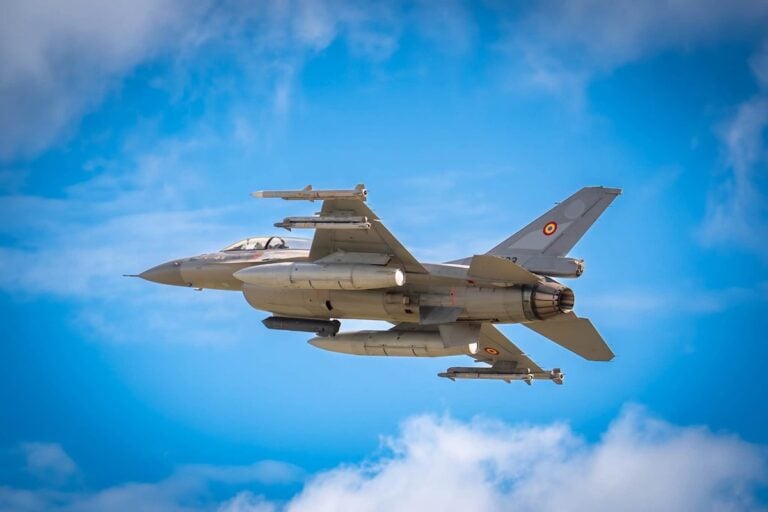
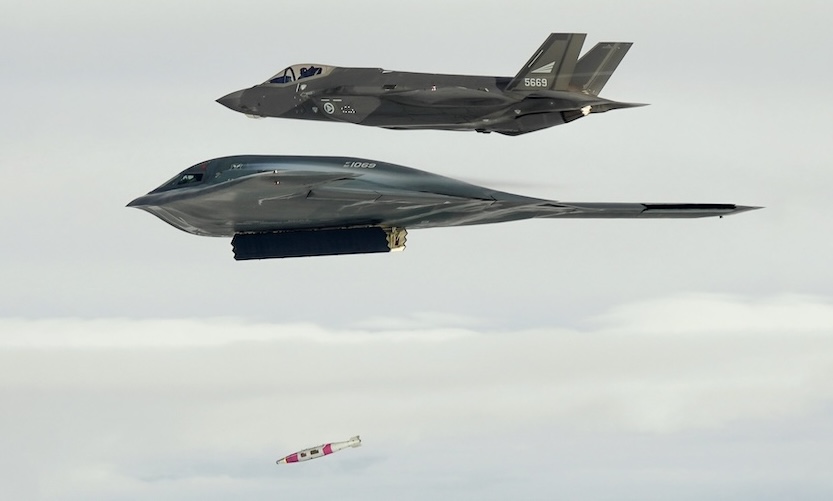
During the September 3, 2025 mission in the Norwegian Sea off northern Norway, a B-2 operated with four Royal Norwegian Air Force F-35s and a P-8 maritime patrol aircraft. The bomber employed the Air Force Research Laboratory’s QUICKSINK precision-guided maritime weapon and sank the surface target.
QUICKSINK is being developed as an air-delivered maritime-strike capability using modified Joint Direct Attack Munitions, with both large and smaller weapon variants under development. The Norwegian mission was the third B-2 demonstration of the capability, following a 2,000-pound GBU-31-based test at RIMPAC 2024 and a 500-pound GBU-38-based test in April 2025.
The combination also highlights the B-2’s large weapons capacity in a maritime-strike scenario. The bomber can carry up to 16 2,000-pound GBU-31s or 80 500-pound GBU-38s in a single sortie, while mixed loads are also possible.
The Norwegian Sea test went beyond demonstrating a new precision weapon. U.S. Strategic Command said the mission validated the B-2’s stealth, range and payload flexibility while reinforcing the aircraft’s evolving role in maritime strike.
Those characteristics make the B-2 one of the most advanced operational bombers in the world and give it strategic value well beyond conventional attacks against fixed land targets. Its combination of low observability, long-range reach and weapons capacity allows the U.S. Air Force to project combat power into distant operating areas, including the Arctic.
Cooperation with Norwegian F-35s was a central element of the mission, rather than a separate fighter deployment. The exercise advanced long-range sensor-to-shooter procedures and incorporated beyond-line-of-sight communications and multi-domain targeting.
“This test is a clear example of how we work with trusted allies to bring new capabilities into play faster and smarter,” said Col. Scott Gunn, commander of the U.S. Air Force’s 53rd Wing. “We’re not just preparing for tomorrow; we’re shaping it together.”
Norway provided access to infrastructure and airspace needed to conduct the test in an operationally challenging environment, while Norwegian Navy and Andøya Space capabilities also supported the operation. Norwegian military officials linked the activity to maintaining security and stability in the High North.
The official statements did not identify Russia as the target of the exercise, but the demonstration has clear relevance to deterrence by showing that U.S. and allied aircraft can locate and destroy maritime targets in Arctic waters. It also showed that the B-2 can operate within an allied combat network rather than solely as an independent long-range strike platform.
The same maritime-strike capability has also been demonstrated in the Pacific, where long distances place a premium on aircraft able to carry weapons deep into the theater. During Valiant Shield 2026, a B-2 from the 509th Bomb Wing destroyed a target vessel in the Philippine Sea on June 27 using an AGM-158C Long Range Anti-Ship Missile.
An F-15E Strike Eagle flew alongside the B-2 during that live-fire mission, combining the stealth bomber with a conventional strike fighter. Defence Industry Europe reported that the exercise reflected the U.S. military’s growing focus on holding naval forces at risk from long range amid China’s expanding naval power in the Pacific.
The Arctic and Pacific missions demonstrated different approaches to attacking ships, with QUICKSINK tested in the Norwegian Sea and LRASM employed in the Philippine Sea. Together, they show how the B-2’s range and payload flexibility can support maritime strike across widely separated theaters while operating with other U.S. and allied aircraft.
The missions also broaden the operational role of an aircraft built around stealth and strategic deep strike. By combining the B-2 with F-35s, maritime-surveillance aircraft and precision anti-ship weapons, the U.S. Air Force is demonstrating a long-range maritime capability that can be deployed from the Arctic to the Indo-Pacific.