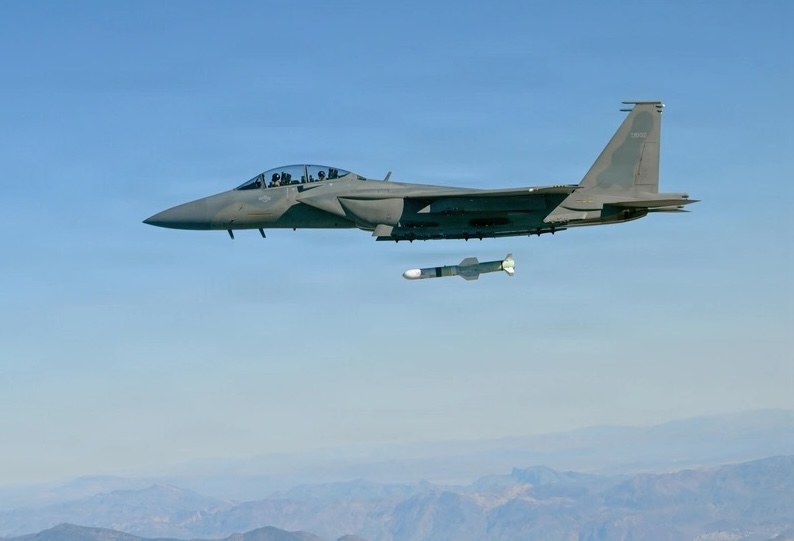
The missiles delivered are the Harpoon Block II variant, which incorporates GPS-assisted inertial navigation. This enables both anti-ship and land-attack capabilities, expanding the system’s operational flexibility.
Officials said the milestone reflects coordinated efforts across program management, engineering, logistics and contracting teams. The work was led by the Navy’s Precision Strike Weapons program office.
Since 1977, the program has delivered nearly 6,000 Harpoon missiles to 30 international partners. The system is available in air-, surface- and submarine-launched configurations, as well as training variants.
The Harpoon is an all-weather, over-the-horizon missile developed by McDonnell Douglas, now part of Boeing, and designed to strike targets at sea and on land. It uses active radar homing and a sea-skimming flight profile to evade defenses and increase survivability.
The missile can be launched from multiple platforms, including fixed-wing aircraft, surface ships, submarines and coastal defense batteries. Variants such as the AGM-84, RGM-84 and UGM-84 are configured for different launch methods, with boosters enabling launch from ships, submarines and ground systems.
Development of the Harpoon began in the 1960s, driven by the growing threat of anti-ship missiles highlighted by the sinking of the Israeli destroyer Eilat in 1967. The first operational delivery took place in 1977, and the system has since evolved through multiple upgrades.
The Block II version builds on earlier variants by enhancing targeting, resistance to electronic countermeasures and effectiveness in littoral environments. These improvements extend the missile’s capability beyond open-ocean engagements to more complex coastal scenarios.
The Harpoon has been widely adopted by U.S. allies and integrated across a broad range of aircraft and naval platforms. Its continued production and upgrades reflect its enduring role in maritime strike, deterrence and multi-domain operations.