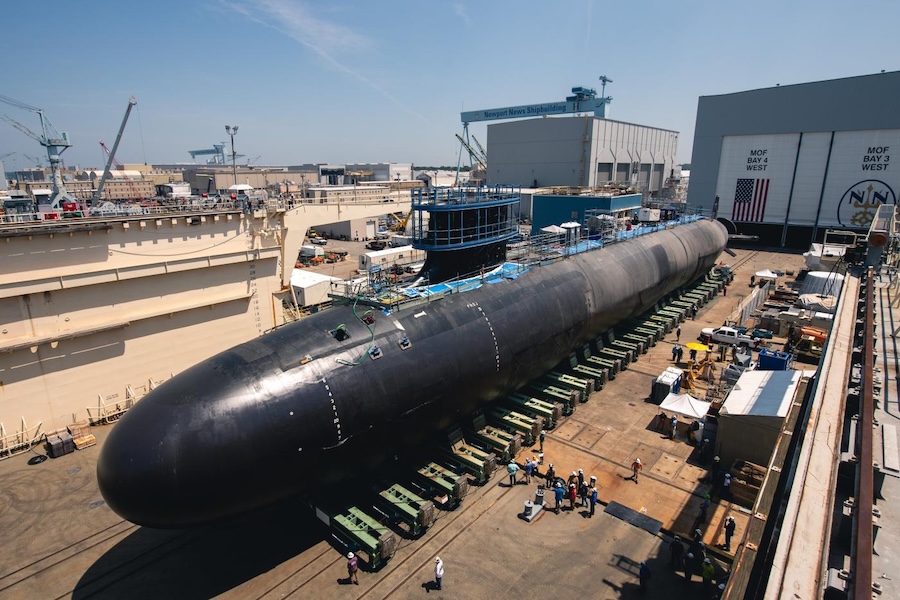
The change applies to Block V and Block VI vessels fitted with the additional payload section. The module extends the hull while increasing weapons capacity and flexibility for other payloads.
“This reclassification is a clear acknowledgment of the increased lethality VPM brings to the undersea fight,” said Vice Adm. Rob Gaucher, Director, Submarine Programs. “These VPM-equipped SSGNs will ensure the Navy continues to dominate the undersea domain for decades to come.”
“By integrating this additional payload capacity, we will have the ability to surge strike power to assure our allies, deter aggression, outmatch any adversary, and give our Fleet commanders an incredibly versatile, hard-hitting instrument of national power,” Gaucher said. Despite the new designation, the vessels will remain part of the Virginia-class program.
The Navy plans to use the submarines for high-volume, long-range precision strikes and other undersea missions. Their expanded payload capacity will also support Distributed Maritime Operations and high-end warfare.
The announcement comes as USS Georgia begins inactivation after more than four decades of service. Georgia is one of four Ohio-class submarines converted into guided-missile and special-operations platforms.
“Reclassifying Virginia Payload Module-equipped submarines as SSGNs accurately reflects the extraordinary strike capacity, operational flexibility, and global reach these platforms bring to the Fleet,” said the Chief of Naval Operations, Adm. Daryl Caudle. “This transition comes at an important moment as USS Georgia, one of the Navy’s four Ohio-class guided-missile submarines, begins the inactivation process after more than four decades of exceptional service.”
“Georgia and her sister ships proved the enduring value of combining undersea stealth with unmatched clandestine strike capability. The next generation of Virginia-class SSGNs builds on that legacy with greater survivability, adaptability, and sustained combat power.”
“These submarines will provide our Nation with a powerful and persistent deterrent, expand options for our combatant commanders, and ensure the Navy remains ready to fight and win whenever and wherever called upon,” Caudle said. The first submarine under the new classification, SSGN 803, is expected to be delivered in fiscal 2029.
Deliveries of all 19 planned submarines are scheduled to continue through fiscal 2038. Once operational, the vessels will provide forward presence, support alliance deterrence and offer additional strike options across global theaters.
“The Submarine Force is defined by our ability to operate undetected and strike without warning,” said Vice Adm. Rick Seif, Commander, Submarine Forces. “By integrating high-volume precision strike capabilities into these stealth platforms, these SSGNs serve as the ultimate enabler for Distributed Maritime Operations, giving our warfighters the overwhelming, flexible firepower required to win decisively in any theater.”
Virginia-class submarines are designed for anti-submarine and anti-surface warfare, precision strike, intelligence collection, irregular warfare and mine warfare. The Navy said the reclassified vessels would use advanced sensors, stealth and automation across open-ocean and littoral missions.