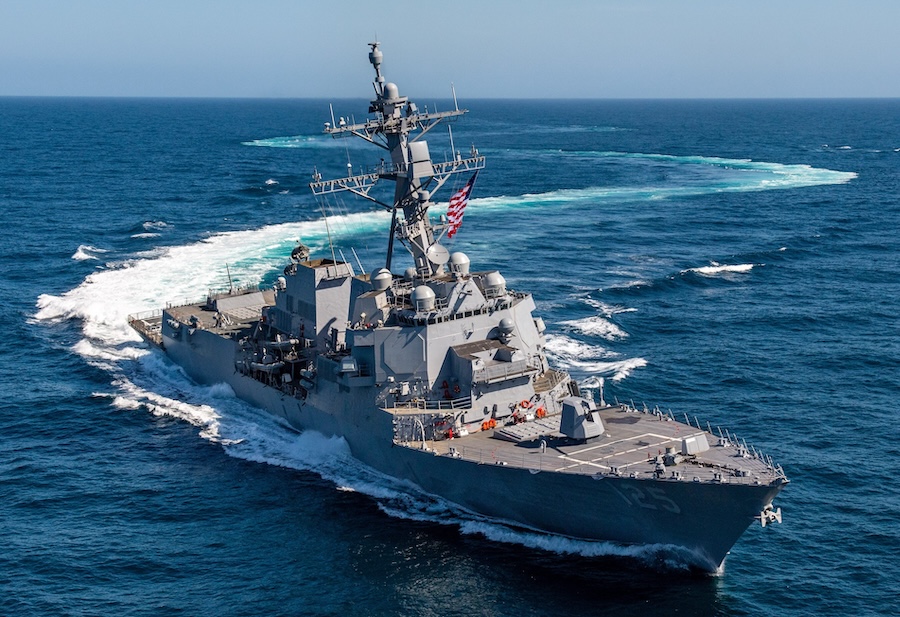
The Navy describes Flight III as a new type-model warship rather than an incremental modification of the existing design. The variant is intended to preserve the destroyer fleet’s ability to protect carrier strike groups and operate in increasingly contested environments.
At the center of the upgrade is the AN/SPY-6(V)1 Air and Missile Defense Radar, paired with the Aegis Baseline 10 combat system. The combination allows crews to detect, track and engage more complex threats at greater distances and in less time than legacy destroyers.
Aegis Baseline 10 is designed to process the increased volume of data generated by SPY-6. The Navy said the system allows Flight III ships to conduct air defense and ballistic missile defense operations simultaneously without a loss of performance.
The radar’s power requirements prompted a broad redesign of the ship’s supporting infrastructure. Flight III uses a 4,160-volt electrical grid in place of the 450-volt system on Flight IIA ships, providing additional capacity for future equipment such as directed-energy weapons.
Cooling capacity has also increased through upgraded air-conditioning systems and a larger chilled-water supply. Each ship has updated gas-turbine generators producing 4 megawatts and a modified steel hull to carry the additional equipment.
Those changes raised displacement to more than 9,500 tons, compared with approximately 9,300 tons for a Flight IIA destroyer. The modifications reflect the scale of the radar, combat-system and power-generation changes incorporated into the variant.
USS Jack H. Lucas, commissioned in October 2023, is the lead Flight III ship and the only operational vessel of the variant. It is undergoing initial operational test and evaluation before assuming the air and missile defense commander role for a carrier strike group.
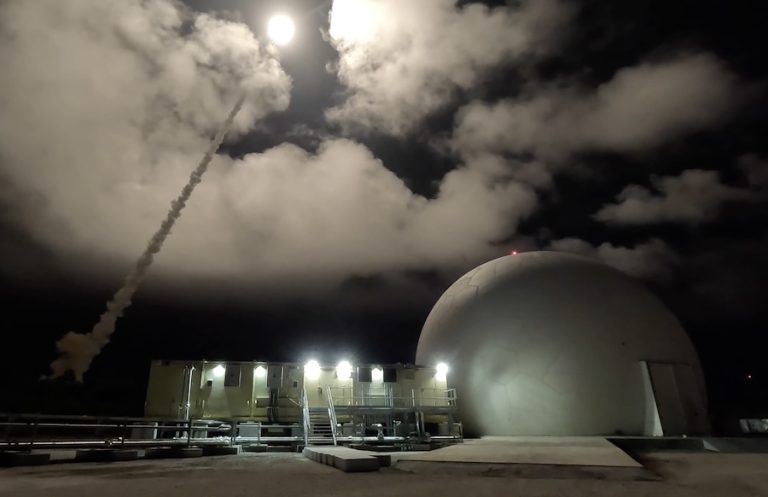
The ship demonstrated its systems during Pacific Dragon 2026, a U.S. 3rd Fleet-led missile-defense event involving the Missile Defense Agency and allied forces around Hawaii. Its testing program will continue under an intensive underway schedule over the next 13 months.
“Jack H. Lucas represents a quantum leap in surface warfare lethality; and our success working with allied forces during Pacific Dragon 2026 proved that our combined integrated air and missile defense capabilities deliver unprecedented dominance in the Pacific,” said Capt. Rob Niemeyer, the ship’s commanding officer. “The real advantage will always be our Sailors—their grit, expertise and dedication are what transform our cutting-edge warship into an unmatched instrument of American sea power.”
The future USS Ted Stevens is approaching commissioning and will become the fleet’s second Flight III destroyer. The vessel recently completed full-ship shock trials using live ordnance to assess whether it can continue operating after exposure to combat-related shock.
“Being part of the first crew on Ted Stevens has been an honor. I think the Flight III’s represent the future of Integrated Air and Missile Defense and an upgrade that strike groups need,” said Capt. Mary Katey Hays, the ship’s commanding officer.
The future USS Louis H. Wilson Jr. is also expected to join the Surface Force as the Flight III fleet expands. Yeoman 1st Class Kristha Hernandez, who is assigned to the ship, said its commissioning would connect the new class with the legacy of its namesake, Marine Corps Gen. Louis H. Wilson Jr.
“Serving on the next class of DDGs represents far more than the achievement of a long-standing career goal,” said Hernandez. “It is an opportunity to be part of the future of the U.S. Navy and contribute directly to its mission of maintaining maritime superiority.”