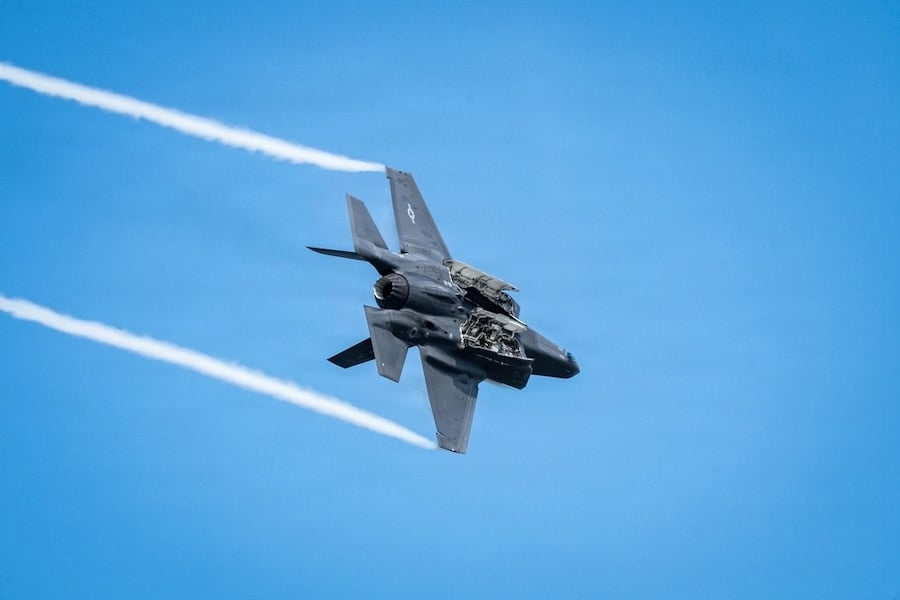
The assessment is contained in the F-35 Modernized Selected Acquisition Report prepared for the fiscal 2027 president’s budget. Effective April 21 and cleared for publication on August 3, the document covers a global fleet of more than 1,200 aircraft.
The problem is not uniform across the fleet. Forward-deployed units continue to record high mission-capable rates, but the wider enterprise is struggling to keep enough parts available and move components through the repair system quickly enough.
Those bottlenecks have pushed the F-35 Joint Program Office to reset its sustainment strategy. The initiative, known as the Global Support Solution, combines improved forecasting with a resized global spares pool and a broad overhaul of aircraft maintenance.
The goal is to support an 80% mission-capable rate and a 65% fully mission-capable rate across the F-35 enterprise. The fiscal 2027 budget also calls for more government depot capacity to repair components that have the greatest effect on aircraft availability.
The repair backlog is already feeding into the program’s long-term cost outlook. The latest estimate includes the expense of clearing a fiscal 2027 backlog of repairable airframe and propulsion components through the sustainment reset.
Projected U.S. operating and support costs have risen to $596.4 billion in constant 2012 dollars, or about $1.395 trillion in then-year dollars. The estimate covers operations through 2083 and is $15.9 billion higher in constant dollars than the program’s 2024 projection.
The increase reflects revised basing plans, new foreign customers, aircraft modifications, propulsion maintenance, combat-data systems, training and depot workloads. The program said 60 affordability initiatives lowered the projection by $23.3 billion in constant dollars, equivalent to $52.2 billion in then-year dollars, keeping the total about 4% below where it otherwise would have been.
Washington is also changing how it buys sustainment services. The Joint Program Office has established a multiyear air-vehicle support contract with four 12-month option periods, giving it more room to tie contractor incentives to supply performance.
Pratt & Whitney continues to receive annual contracts for F135 engine support. The program is considering longer-term, outcome-focused agreements for both the aircraft and engine to give suppliers more predictable demand and improve support performance.
The F135 maintenance system shows why the changes are needed. Material has been shifted from sustainment to production under the engine’s performance-based logistics contract, contributing to delays in module repairs.
Repair requirements have also exceeded earlier estimates after workers found additional damage while disassembling engine modules. Parts shortages, transportation problems, late depot arrivals and more complicated repairs have added to turnaround times.
Aircraft reliability remains another area of concern. Demonstrated mission reliability for the conventional-takeoff F-35A stood at 85.3%, below its 93% threshold, while the carrier-based F-35C recorded 92.2% against a 95% requirement.
The short-takeoff and vertical-landing F-35B performed better, recording mission reliability of 96.4% against a 95% threshold. Mission reliability measures whether an aircraft completes its assigned mission and is separate from the broader mission-capable rate used to track fleet availability.
The Joint Program Office is pursuing a large portfolio of improvements. Between 2022 and 2025, 55 reliability and maintainability projects completed development and began moving into the fleet, while another 64 were under contract.
A further 30 projects had funding allocated and were expected to be placed under contract during 2026. Another 52 remained at various stages of development and may receive funding later.
Software stability improvements, Technology Refresh 3 and Block 4 upgrades are expected to support the same effort. Planned engine and power-management improvements are projected to increase engine time on wing by 16% to 25%, reducing how often engines need to be removed for maintenance.
The pressure on the support network is growing with the fleet itself. The F-35 enterprise delivered a record 191 aircraft in calendar year 2025, including jets previously held back because they lacked the required Technology Refresh 3 capability.
The fiscal 2027 budget would extend that expansion with 85 U.S. aircraft in Lot 21. Hitting the 2030 readiness target will depend on whether the parts and repair network can keep pace with the number of F-35s entering service.