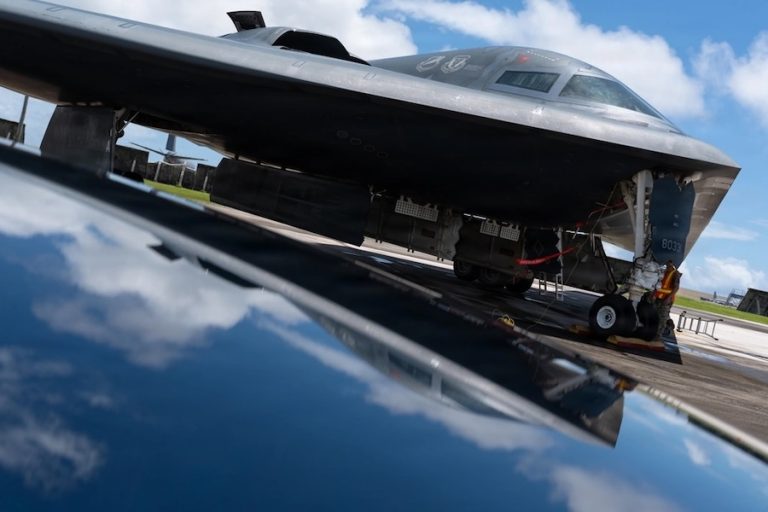
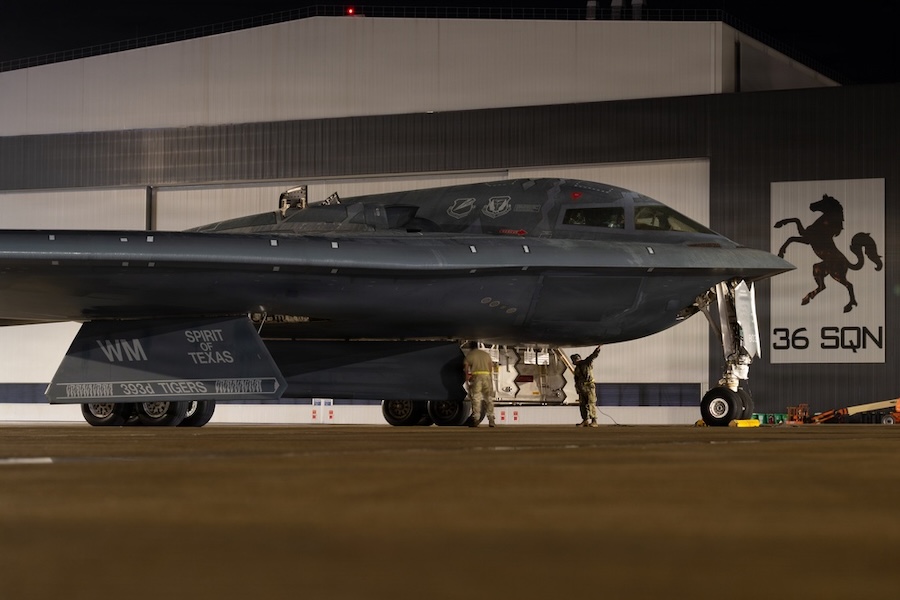
The bomber, named “Spirit of Texas” and marked with the 393rd Bomb Squadron’s “Tigers” insignia, belongs to the 509th Bomb Wing at Whiteman Air Force Base, Missouri. It arrived in Australia on June 10 as part of a Bomber Task Force rotation built around Exercise DIAMOND STORM, a deployment designed to test how far — and how seamlessly — American strategic airpower can project into the Indo-Pacific.
Getting there required more than sixteen hours in the air and several rounds of aerial refueling, captured in imagery from both the tanker’s boom-operator camera and the B-2’s own cockpit, where pilots tracked the fuel transfer on internal displays during the long transit across the Pacific. That refueling choreography is not incidental — it is the mechanism that turns a bomber based in rural Missouri into a strike asset capable of reaching almost anywhere on the globe without ever touching down on foreign soil.
The B-2 remains the only aircraft in the U.S. Air Force’s inventory built for that mission: penetrating contested, heavily defended airspace and striking targets that other aircraft cannot reach undetected. Its ability to fly extended combat sorties directly from the continental United States, rather than staging from forward bases that could be targeted in a conflict, is precisely what gives the bomber its strategic value — and what distinguishes Bomber Task Force deployments from a routine training exercise.
Australia supplied its own piece of the puzzle. Royal Australian Air Force KC-30A tankers refueled the bombers alongside U.S. Air Force KC-135 Stratotankers assigned to Pacific Air Forces, with Australian ground crews and aircrew working the flight line beside their American counterparts throughout the rotation — a detail that speaks to the alliance underpinning the mission as much as the aircraft itself.
Bomber Task Force rotations have become a recurring fixture of U.S. Pacific strategy, cycling B-2s, B-52s and B-1s through allied airfields to give crews practice operating far from home station while reminding potential adversaries of America’s reach. The exercises have taken on added weight as strategic competition with China intensifies across the Indo-Pacific, with defense officials increasingly pointing to the B-2’s long-range strike capability as a cornerstone of U.S. deterrence in the region.