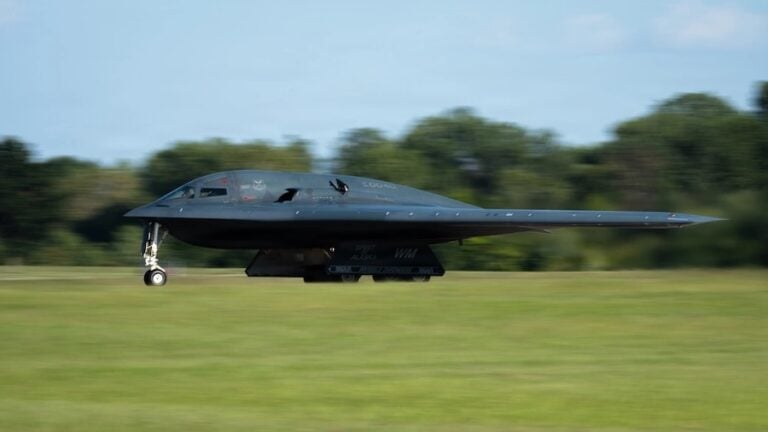
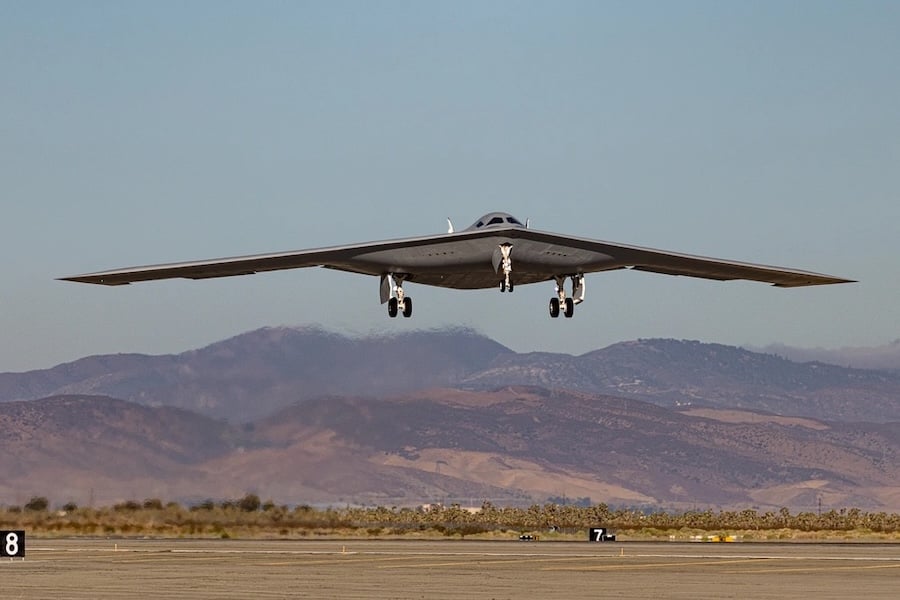
The video emerged days after footage circulated of Chinese military aircraft under development, including the J-36. The timing places the B-21 program against the broader backdrop of U.S.-China competition in advanced combat aviation, with Washington also developing the F-47 fighter.
Northrop Grumman describes the B-21 as the world’s first sixth-generation aircraft to enter flight testing. The bomber is intended to replace the B-2 Spirit and carry both conventional and nuclear payloads on long-range missions.
The company said flight testing has demonstrated the performance of the aircraft’s low-observable design. New composite materials and updated manufacturing processes are intended to reduce radar and infrared signatures while lowering maintenance demands compared with earlier stealth aircraft.
Dorito Day today! And to think, this wasn’t the only dorito of the day… #B21 #B21Raider pic.twitter.com/a8Paoftw7A
— jmh.creates (@JarodMHamilton) September 24, 2026
Fuel-efficient engines integrated into the airframe are designed to reduce the B-21’s reliance on aerial tankers. Northrop Grumman said the change would extend mission persistence and release refueling capacity for other joint-force operations.
The company said most B-21 test sorties have achieved “code one” status, meaning the aircraft returned without maintenance problems and was ready to fly again. Ground-test results have also exceeded predictions generated through digital modeling, according to Northrop Grumman.
Test pilots have reported high stability and control during aerial refueling. Northrop Grumman said those characteristics could reduce training requirements and shorten refueling operations.
The company has invested more than $5 billion in digital and manufacturing infrastructure for the B-21 program. Its digital engineering system has reduced software-certification time by 50% and supports real-time validation of aircraft performance during testing.
Northrop Grumman is also using digital and augmented-reality tools to help technicians review assembly tasks and resolve production issues before working on an aircraft. More than 8,000 industry and Air Force personnel support the program through a network of over 400 suppliers across 40 states.
The Air Force has access to program data that includes the B-21 digital twin, which is intended to support future upgrades. The aircraft’s open architecture is designed to simplify the integration of new software, mission systems and weapons as requirements change.
The B-21 is intended to operate within a wider family of systems by integrating data, sensors and weapons. Its architecture also supports networked operations with other crewed and uncrewed platforms.
Like the B-2, the B-21 will carry weapons inside internal bays to preserve its low-observable profile. Available images appear to show one large weapons bay and potentially two smaller compartments.
Earlier reporting identified the AGM-181 Long-Range Standoff cruise missile, AGM-158B JASSM-ER and AGM-158C LRASM as potential weapons for the B-21. Air-dropped weapons, including the GBU-57 Massive Ordnance Penetrator, were also identified as possible payloads.