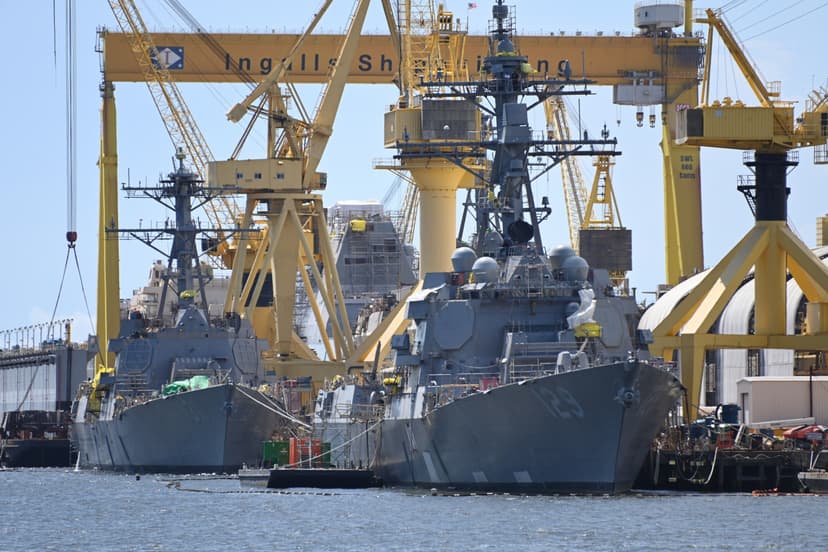
Eric Chewning, HII’s executive vice president of maritime systems and corporate strategy, detailed the plan during a House Appropriations Subcommittee on Defense field hearing at College of the Canyons. Chewning, a former deputy assistant secretary of defense for industrial policy, said higher output would depend on workforce development, upgraded infrastructure and a broader maritime supply chain.
“In 2025, throughput in our shipyards increased by 14% year-over-year,” Chewning said. “We are targeting a 15% year-over-year throughput increase in 2026.”
The strategy centers on hiring, teaching and retaining skilled workers, while investing in shipyard technology that includes the use of physical artificial intelligence in production. HII also plans to expand its supplier network and use distributed shipbuilding to move more work beyond its main facilities.
The company expects to outsource more than two million hours of work in 2026, a 178% increase from 2024. HII said the approach would increase throughput, support employment across the country and give small and medium-sized suppliers greater confidence to invest in additional capacity and workers.
HII has also entered new collective bargaining agreements that provide competitive wage increases intended to retain its skilled workforce, with support from Congress and the Navy. The company presented the workforce measures as a core part of its effort to sustain higher production rates.
“America’s ability to maintain peace and defend our interests depends on a strong, secure, and ready industrial base,” Chewning said. “At HII, our mission to deliver the world’s most powerful ships and all‑domain solutions is only possible because of our dedicated workforce and the continued support of Congress and the U.S. Navy.”
Chewning pointed to Newport News Shipbuilding’s Charleston Operations as a model for expanding the maritime industrial base. HII worked with the Navy, South Carolina and the Department of Defense’s Industrial Base Policy Office to convert the underused facility into an advanced manufacturing campus supporting submarine production and skilled-trade jobs.
“This is a powerful example of what can be achieved when industry, the federal government, and state partners work together to strengthen America’s maritime dominance,” Chewning said. “We thank the U.S. Navy, Congress, and specifically the House Defense Appropriations Subcommittee for their continued support and look forward to working together to ensure America’s maritime superiority for generations to come.”
HII employs about 45,000 people and supplies ships, unmanned systems and other defense technologies to U.S. and allied customers. Its portfolio also includes command-and-control systems, intelligence and surveillance capabilities, electronic warfare, artificial intelligence and synthetic training.