
Taiclet outlined the investment program during Lockheed Martin’s second-quarter 2026 earnings call. He said the company began adding munitions capacity before customers placed firm orders.
That strategy is now supporting several large missile awards. Taiclet said the contracts would expand manufacturing capacity, diversify supply and strengthen surge production.
The Missile Defense Agency awarded Lockheed Martin a seven-year, $35 billion THAAD contract. The agreement calls for interceptor production to increase fourfold.
The U.S. Army also awarded a $3 billion GMLRS production contract. Lockheed Martin secured a separate HIMARS award valued at up to $1.1 billion.
Taiclet said the programs were significant as a combined industrial investment. They will add capacity, new supply sources and greater resilience across the U.S. production base.
Lockheed Martin is expanding several domestic facilities to support the production ramp. Taiclet said the company’s balance sheet and cash generation could finance billions in planned investments.
The company opened a new missile assembly building in Courtland, Alabama. The facility will become the future home of the Next Generation Interceptor program and support work related to THAAD.
Lockheed Martin also broke ground on a munitions production center in Troy, Alabama. The project will add 87,000 square feet of production space for interceptors and future NGI work.
A separate facility is under development in Titusville, Florida. Taiclet said the site would support development of the Trident II missile.
The company is pairing new factory space with automation, robotics and artificial intelligence. Taiclet said those technologies were becoming part of Lockheed Martin’s production infrastructure.
AI-supported analytics are used to optimize equipment performance. Predictive maintenance reduces downtime, while machine-learning systems streamline quality inspections.
Lockheed Martin is also working with GM Defense to examine commercial manufacturing methods. The companies are studying how automotive production and supply-chain practices could increase defense output.
Taiclet said the collaboration could give Lockheed Martin access to the speed and scale of the U.S. commercial industrial base. The approach is intended to help production keep pace with demand.
International partnerships form another part of the capacity plan. Taiclet said co-production can provide additional capital, factory space and skilled workers.
The strategy also places production, repair and overhaul capabilities closer to deployed U.S. forces and allied customers. Lockheed Martin assesses each project against the expected returns once contracts are secured.
Lockheed Martin and Rheinmetall are planning a European center for ATACMS production. The companies signed a memorandum of understanding during the NATO summit.
Taiclet said ATACMS production could move into Rheinmetall factory space in Germany. That would create additional room for PrSM production at Lockheed Martin’s Camden, Arkansas, facility.
The PrSM line is highly automated and supported by artificial intelligence. Expanding it within the existing Camden footprint could avoid the cost and time of constructing another building.
Lockheed Martin is also supporting plans for a dedicated PAC-3 maintenance facility in Europe. Taiclet said the proposal would place support capacity closer to allied operational requirements.
Taiclet referenced an initial estimate of $8 billion to $9 billion for the wider munitions expansion. He said the company was seeking faster production while reducing capital and operating costs where possible.
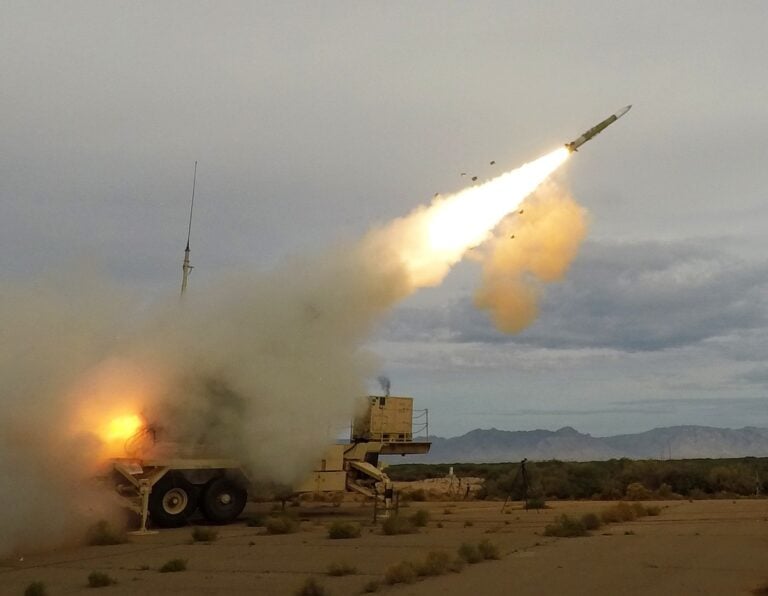
The U.S. government has asked Lockheed Martin to triple PAC-3 MSE production and quadruple THAAD output. The company must also accelerate PrSM production beyond its previous plans.
Taiclet said the government was allowing greater flexibility on requirements to support faster expansion. Lockheed Martin is combining that flexibility with domestic investment, automation and allied industrial capacity.