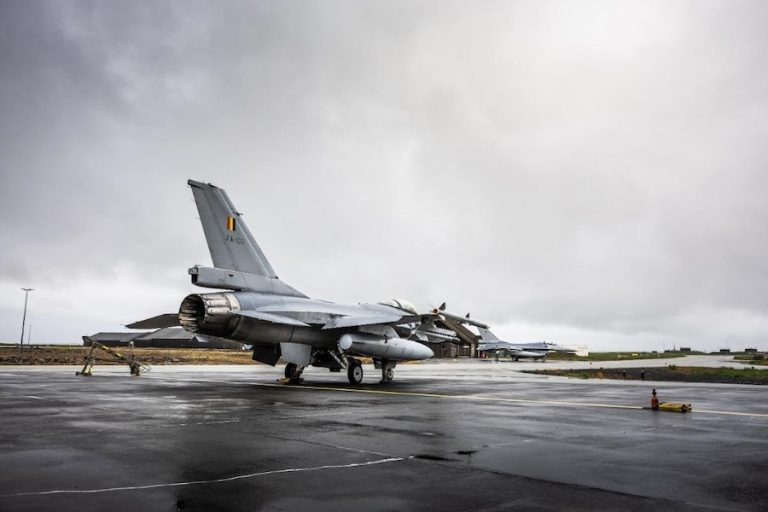
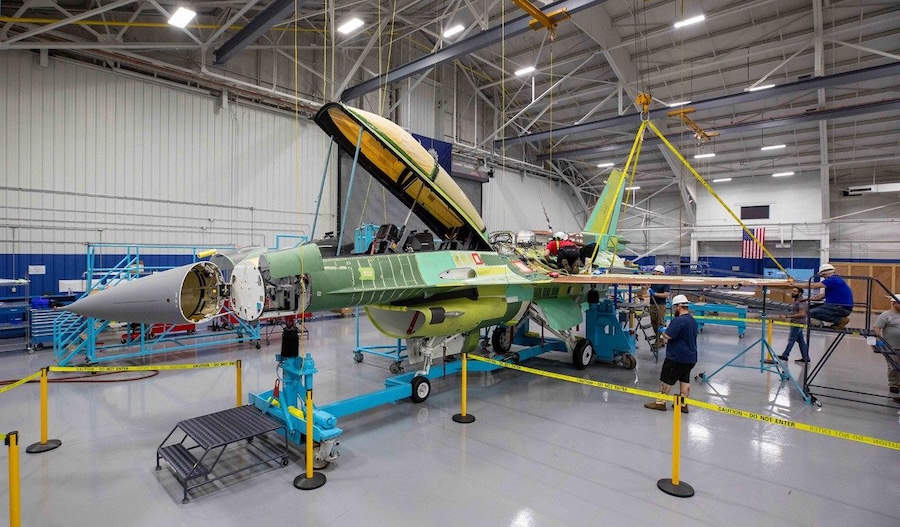
Chief Executive Jim Taiclet said during Lockheed Martin’s second-quarter 2026 earnings call that the company had restarted customer handovers during the period. Two F-16s were delivered in the quarter, marking a return to deliveries after the earlier disruption.
“Our team’s operational execution hit its stride this quarter as we fulfilled key delivery and technical obligations throughout the portfolio,” Taiclet said. “We resumed deliveries for the F-16 and increased output of C-130 aircraft. Two F-16s and seven C-130s were delivered to customers this quarter.”
Chief Financial Officer Evan Scott later provided more detail on the problem, saying a flight test of a new F-16 variant did not meet the company’s or its customer’s expectations. Lockheed Martin then completed a redesign, repeated the flight test and restarted deliveries.
“A new variant that we had a flight test this year didn’t quite meet our expectations of what we expect for us and our customers,” Scott said. “We did a redesign, got the redesign complete, redid flight test, and began deliveries again on F-16.”
Management did not identify the variant involved or disclose the technical issue during the call. It also did not provide the cost of the redesign or a specific full-year F-16 delivery target.
The return to deliveries is important for a program carrying a substantial international order book. Lockheed Martin data show 119 Block 70/72 aircraft in backlog, 41 delivered and customers in seven countries, with about 530 suppliers supporting the program worldwide.
Scott said F-16 deliveries will increase this year compared with 2025, placing the fighter within a broader production ramp across Lockheed Martin’s portfolio. “In Aeronautics, F-16 and C-130 all deliver more this year versus last year,” he said. “We are in a scaling mode right now.”
The F-16 recovery follows financial charges taken earlier in 2026 and operational challenges that continue to affect the Aeronautics segment’s outlook. Management said first-quarter issues on the F-16 and C-130 were among the factors weighing on margins even while the company expects Aeronautics sales growth to accelerate in the second half.
Scott pointed to the fighter program as evidence of Lockheed Martin’s ability to correct technical problems without losing sight of higher production requirements. “The F-16, which although we took charges earlier this year, is a great example of that,” he said.
“One of the things that we continuously demonstrate is that our platforms, we continue to iterate and evolve them and improve them,” Scott added. “An F-16 today is very different from an F-16 when we started production.”
That evolution is now centered on the Block 70/72 configuration for new-production aircraft. Lockheed Martin says the version combines an APG-83 active electronically scanned array radar, upgraded mission computer and avionics architecture, infrared search-and-track capability, advanced datalinks and weapons, new cockpit displays and a digital flight-control computer.
The APG-83 gives the F-16 radar technology derived from the company’s fifth-generation fighter programs, using hardware and software commonality with the F-22 and F-35 AESA radars. The Block 70/72 also incorporates an internal electronic-warfare system with a digital radar-warning receiver and jammer technology.
The new-production fighter has a structural service life of 12,000 hours, while its updated mission computer combines weapons and avionics computing into a single system intended to accommodate software upgrades over time. Lockheed Martin says the configuration is designed to keep the F-16 flying and fighting into the 2060s and beyond.
The broader F-16 fleet remains one of the largest Western combat-aircraft fleets in service. Lockheed Martin data show about 2,800 F-16s operating in 29 countries, with more than 21 million flight hours and 14 million sorties accumulated across the program.
The international customer base is also continuing to generate new production and sustainment work. Peru signed a contract for the Block 70 in April, Slovakia reached a sustainment agreement in May covering its Block 70 fleet through 2030, and Lockheed Martin signed a July letter of intent with Sabena Engineering to explore expanded regional F-16 sustainment support.