InterRoC VII, or Interoperable Robotic Convoy VII, is the latest stage in a research series focused on autonomous convoy operations. The project is intended to develop highly automated convoy control and test vehicle formations in which different platforms can operate together safely and autonomously.
The work will centre on automation, perception, decision-making and route planning for mixed military vehicle formations. Rheinmetall said these functions are needed to ensure reliable convoy management under demanding operational conditions.
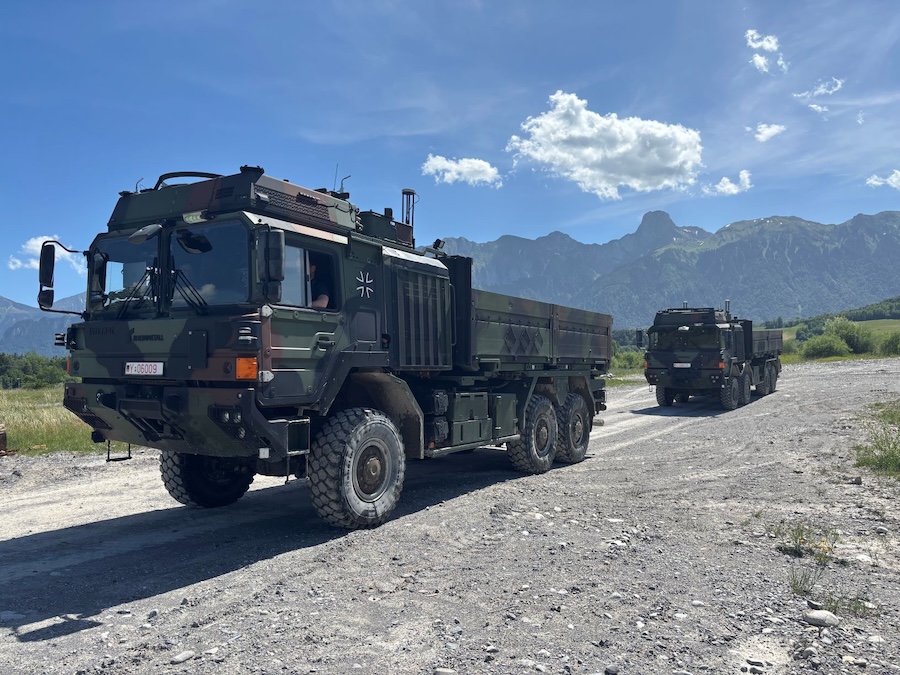
The project will use vehicles from Rheinmetall MAN Military Vehicles’ HX family as its technological basis. The logistics vehicles are fitted with Rheinmetall’s modular PATH sensor kit and a drive-by-wire kit integrated into the vehicle architecture.
Rheinmetall said the open architecture allows further sensors, AI-based software functions and mission-specific algorithms to be added over time. This is intended to create a scalable autonomy platform that can be adapted to future requirements and new mission scenarios.
A central element of the research is the ability to operate without reliable satellite navigation. Rheinmetall said the vehicles can map their surroundings, determine their position and conduct complex convoy operations even in GNSS-denied environments.
That capability is designed for electronically contested areas where satellite-based navigation may be disrupted or unavailable. Rheinmetall said it builds on the company’s existing work in autonomous land vehicles for both road and off-road military use.
The company took over the project shortly before achieving the top ranking in the “Convoy Scenarios” category at the 2026 European Land Robot Trial in Thun, Switzerland. Rheinmetall said the event allowed it to demonstrate autonomous logistics systems in challenging convoy and transport conditions.
The capabilities shown at ELROB 2026 will feed directly into InterRoC VII. The trials provided a setting to test autonomous convoy management, sensor fusion and decision-making algorithms alongside international armed forces, research institutions and industry partners.
Rheinmetall said the project is intended to improve the efficiency and resilience of military supply chains. By automating transport tasks, the company said such systems can also reduce risks to personnel deployed in the field.
Driveblocks GmbH is supporting the project as a specialist provider of software and AI for object classification and environmental awareness. Its modular autonomy and perception systems combine camera and LiDAR sensor fusion with AI-based models for real-time 3D mapping, terrain recognition and safety-critical decision support.
The technology is designed for difficult off-road conditions, including unstructured terrain, vegetation, dust, snow and changing visibility. Rheinmetall said similar systems are already being used in defence, construction and agriculture applications.