The order was booked in July 2026 under a framework contract awarded at the end of 2024. It is the largest contract received to date by Rheinmetall Project Solutions GmbH, with production scheduled to begin in the first quarter of 2027.
Germany’s Federal Office of Bundeswehr Equipment, Information Technology and In-Service Support, or BAAINBw, originally commissioned Rheinmetall in December 2024 to supply up to 137 rescue stations. The initial order covered 10 ballistically protected systems and six unprotected versions.
The framework contract includes options for additional armoured and unarmoured systems as well as training for Bundeswehr personnel. The July call-off adds 149 systems to the programme.
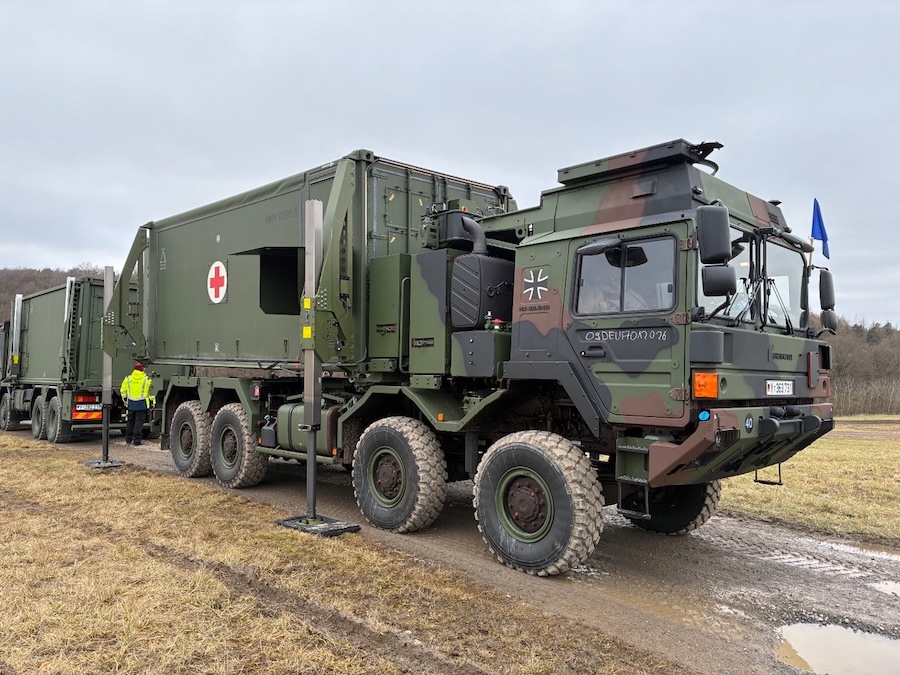
The rescue stations form part of the Bundeswehr’s Modular Medical Facilities system and provide initial emergency medical care for troops. Rheinmetall said their high mobility reflects lessons from the war in Ukraine, where medical support systems must be able to relocate quickly.
Four soldiers can set up or dismantle each station within a short period. Each system consists of two containers that can operate together or independently for several days.
Both containers have their own generator and air-conditioning system. If one generator fails, the complete facility can continue operating using power from the remaining container.
Each station includes a fully equipped emergency treatment area and four additional treatment positions. Medical equipment is mounted on Airliner rails, allowing the internal configuration to be adapted to user requirements.
The systems can be transported using different Bundeswehr carrier vehicles and deployed on sloping terrain. Rheinmetall developed a dedicated lifting system because existing commercial solutions did not meet the specified requirements.
The Bundeswehr is procuring both protected and unprotected variants as part of the programme. The new configuration replaces a more complex tent structure with a modular 3:1 container produced by Rheinmetall Mobile Systeme GmbH, allowing deployment in more challenging terrain.