
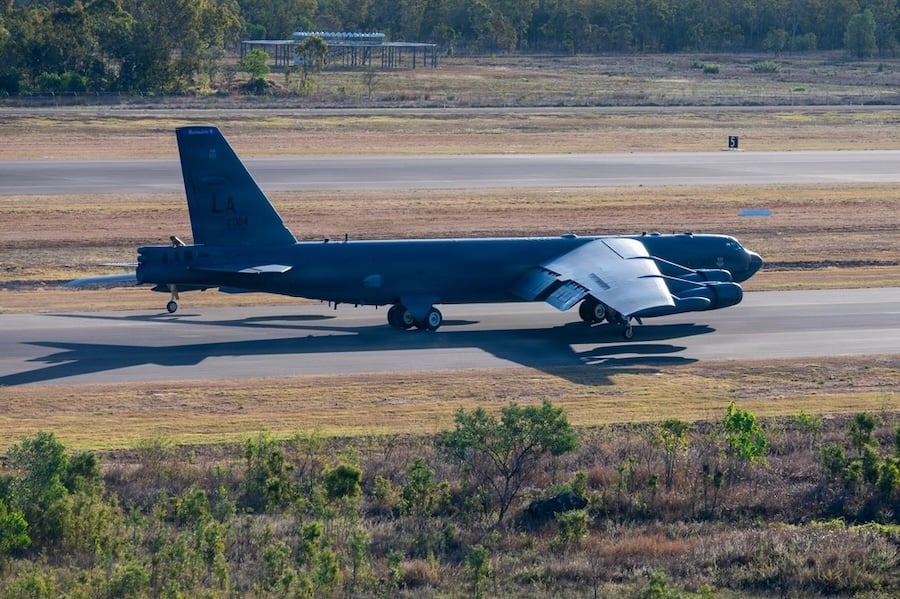
The deployment demonstrates the service’s “ability to project, sustain, and regenerate decisive airpower across an expanding extended network”, the U.S. Air Force said. It also provides an opportunity for American and Australian forces to conduct joint patrols and training in the region.
“BTF missions, including joint air patrols and training exercises, enhance our readiness and provide training necessary to respond to any potential crisis or challenge in the Pacific,” the service said.
Bomber Task Force deployments are intended to keep aircrews prepared for operations across the Pacific and validate the Air Force’s global strike capability. The service said maintaining a combat-ready force with depth and breadth of capability remained a priority for Pacific Air Forces.
“Operating out of RAAF Base Tindal highlights our shared commitment to regional stability, ensuring our forces remain agile and responsive in support of a Free and Open Indo-Pacific,” the Air Force said.
The B-52H is a long-range heavy bomber designed to conduct nuclear and conventional missions. It can operate at high subsonic speeds at altitudes of up to 50,000 feet and carry nuclear weapons or precision-guided conventional munitions.
In a conventional conflict, the aircraft can perform strategic attack, air interdiction, close-air support, offensive counter-air and maritime missions. Its precision-navigation capability allows it to strike targets across long distances and operate in varied mission environments.
The bomber can be equipped with electro-optical viewing sensors, forward-looking infrared systems and advanced targeting pods. These systems support target identification, stabilized surveillance, battle assessment and flight safety.
The targeting pods improve long-range detection and allow crews to maintain continuous surveillance of potential targets. Their targeting and image-processing technology supports operations by day, at night and in adverse weather using weapons including laser-guided bombs, conventional bombs and GPS-guided munitions.
Aerial refueling gives the B-52 a range limited primarily by aircrew endurance. The aircraft has an unrefueled combat range of more than 8,800 miles, or 14,080 kilometers.
The H model is the only B-52 variant remaining in the U.S. Air Force inventory. It serves with the 2nd Bomb Wing at Barksdale Air Force Base in Louisiana, the 5th Bomb Wing at Minot Air Force Base in North Dakota and the Air Force Reserve Command’s 307th Bomb Wing at Barksdale.