
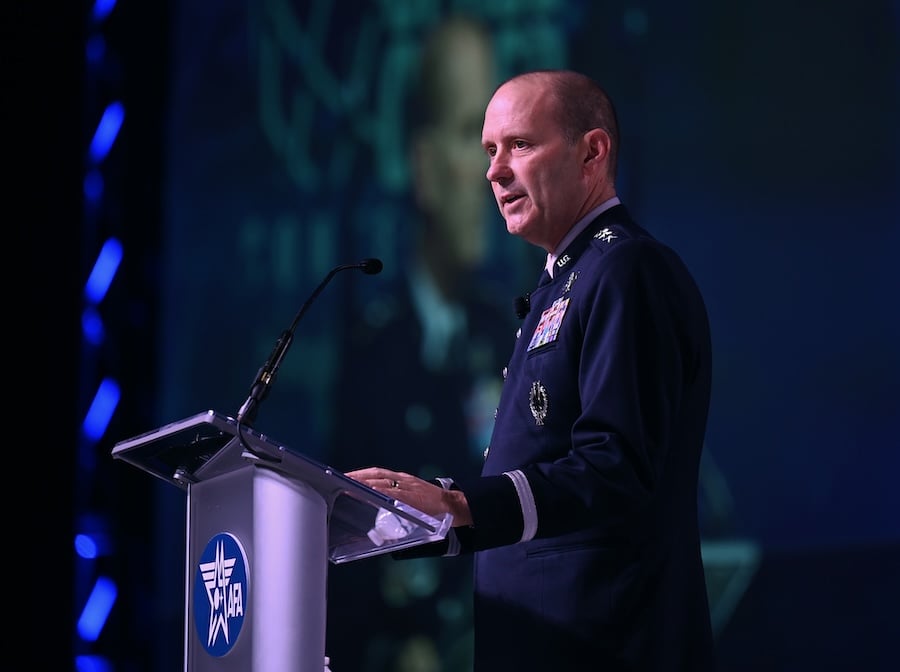
Schiess announced the priorities during a September 15 address at the 2026 Air, Space & Cyber Conference, 12 days after becoming the service’s senior uniformed leader. His agenda is focused on building a common Guardian identity, expanding and arming the force, and delivering space capabilities across the joint force.
The first priority, Forge the Guardian Ethos, seeks to establish a shared military identity across the service. Schiess said personnel should identify first as Guardians, whether they work in acquisition, space operations, intelligence or cyber operations.
“The Space Force acts together as one Guardian team—a military force uniquely trained and equipped to deliver unparalleled space warfighting advantage,” he said. Schiess cited military training instructors and younger personnel already operating capabilities that were regarded as science fiction only a few years ago.
His second priority, Arm and Grow the Guardian Force, addresses the scale, equipment and organizational structure of the service. Schiess said U.S. advantages in space are being challenged by adversaries that are rapidly fielding counterspace systems.
“Today’s advantage cannot be assumed for tomorrow,” Schiess said. “We face determined and credible adversaries who are building and fielding counterspace systems at incredible speeds to target directly the United States’ space advantage.”
The remarks followed Department of the Air Force Secretary Troy Meink’s statement that the Space Force has weapons in space. Schiess linked those capabilities directly to the defense of the joint force.
“Today, Guardians operate on-orbit weapons that can defend the Joint Force against space-enabled attacks,” Schiess said. “We will make disciplined and responsible choices about how we build and sustain our combat advantage, which means scaling our ability to respond to threats.”
Schiess said force growth must be accompanied by changes to acquisition processes, authorities and organizational structures. Those changes are intended to speed the delivery of operational capabilities to military commanders.
He pointed to the recent VICTUS HAZE mission, which demonstrated an ability to launch and respond to an on-orbit threat within 17 hours. The mission brought together industry, Space Systems Command, Combat Forces Command and several acquisition and operational units.
“Space Systems Command, our industry partners, and Combat Forces Command proved to the world that if an adversary targets the United States Space Force, we have the capability to deliver a swift response and we are going to continue working on getting faster and faster,” Schiess said. The demonstration reflected the service’s effort to shorten the time between detecting a threat and fielding a response.
The third priority, Integrate Guardian Power at Scale, calls for embedding space personnel and expertise directly into frontline operations. Schiess said Guardians are already contributing to military activity across several combatant commands.
He cited a Guardian deployed with the 42nd Electronic Warfare Detachment in the U.S. Central Command region during Operation Epic Fury. She reconfigured her weapon system and conducted non-kinetic fires during a missile attack, remaining at her console until ordered to seek safety.
“Our components, notably at U.S. Central Command and Space Command, with support from components at European Command and Pacific Command, demonstrated that Guardians are not supporting from the sidelines as a ‘nice to have,’” Schiess said. “We are delivering spacepower directly into the fight as a ‘need to have.’”
Schiess said the Space Force must maintain a pipeline of trained personnel equipped with advanced systems for operations at home and overseas. He also pledged to strengthen support networks for Guardians’ families.
“Deterrence is strongest when we have a credible force and the resolve to use it,” Schiess said. “That is what the Space Force brings to you…by delivering space superiority and by ensuring we get after our nation’s interests in, from and to space.”