
That would come one year after the project’s launch. Swarm Forge began in January 2026 as the department’s Pace-Setting Project #1.
It is a cornerstone of the department’s Artificial Intelligence Strategy. The stated directive is to accelerate America’s military Super Intelligence dominance through highly iterative, field-tested technologies.
The department describes the project as a proving ground for future robotic forces and the tactical operators who command them. It runs under the Direct Reporting Portfolio Manager for Unmanned Systems.
The department calls the project an operational shift from legacy procurement models. It sets up a continuous, hands-on “combat season” environment.
Elite military operators, commercial technology innovators and government experts co-develop software, hardware and tactical concepts under real-world conditions. The department said this compresses the traditional acquisition timeline into a 90-day zero-to-deployment pipeline.
Drone capabilities move straight from field testing to operational use by trained warfighters. The model replaces traditional government acquisition programs with a competitive “team-of-teams” environment.
The department sets the operational challenges. Commercial technology companies compete and integrate directly alongside Special Operations Forces operators in the field.
The cut in the number of companies came through continuous field testing. The department said the process ensures that only the most resilient, platform-agnostic and capable systems keep receiving development support.
The second quarterly field Crucible took place in June. The department said it validated the program’s primary objectives.
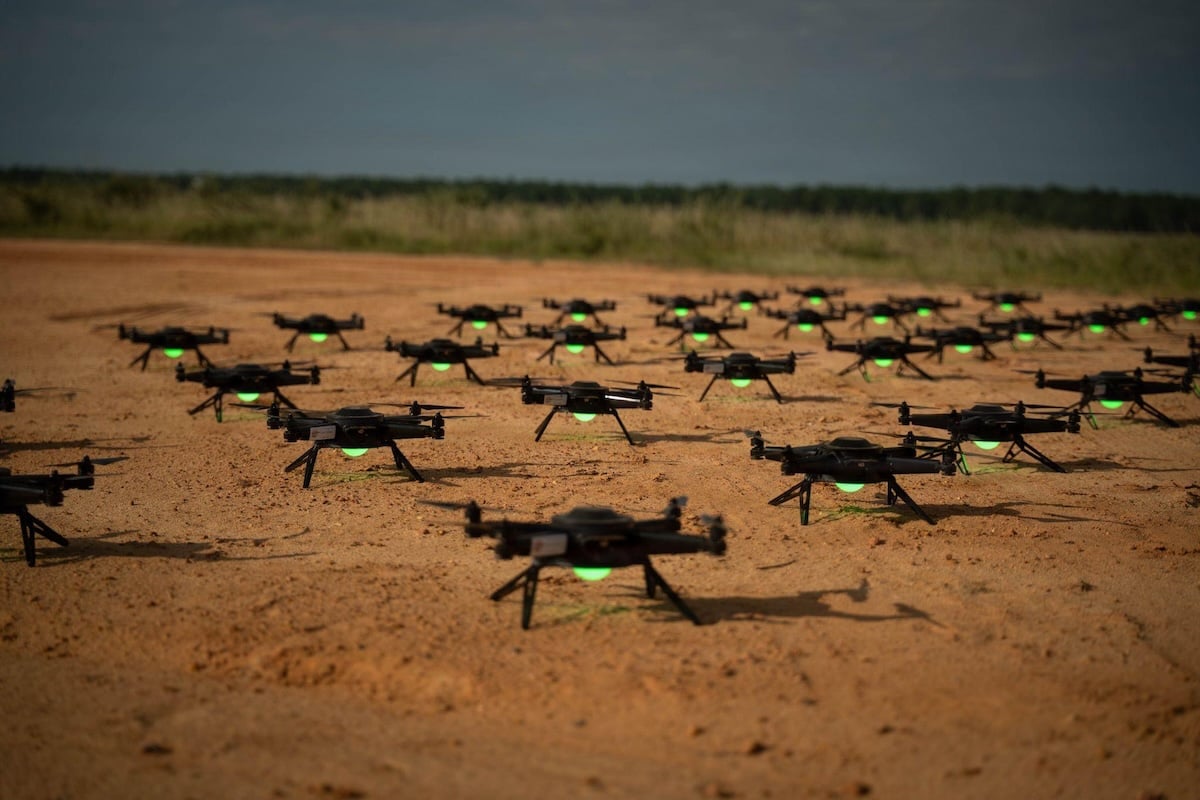
An advanced SI battle manager orchestrated air and ground systems while human operators remained “on-the-loop.” The department said this demonstrated that heterogeneous swarms can act as immediate, scalable force multipliers.
The third quarterly Crucible followed in September at Fort Bragg, North Carolina. It introduced a more complex and difficult operating environment designed to mirror the contested conditions of near-peer conflicts.
Vendors demonstrated their systems’ adaptability under electronic warfare interference, at night and in complex terrain. The fourth field Crucible is scheduled for late January 2027 at Camp Lejeune, North Carolina.
Information from the quarterly Crucibles also supports other pace-setting projects. It provides real-world drone behavior data for the development of SI-enabled simulations.
The department’s Chief Digital and Artificial Intelligence Office leads the project with U.S. Army Special Operations Command. The department said the project is moving on an aggressive wartime footing to close the joint force’s inventory and doctrinal gaps in massed, low-cost robotic systems.