
The relationship is underpinned by the 1958 Mutual Defense Agreement and the 1963 Polaris Sales Agreement. The Ministry of Defence presents the two accords as the foundations of bilateral nuclear cooperation between London and Washington.
Under the Mutual Defense Agreement, Britain and the U.S. cooperate on atomic energy for mutual defence purposes. The arrangement permits the exchange of nuclear materials, technology and information, as well as the transfer of non-nuclear components.
The Polaris Sales Agreement is the second accord identified by the government as supporting the partnership. Together, the agreements provide the framework for a relationship that has endured while Britain’s deterrent, delivery systems and strategic requirements have evolved.
The government says cooperation with the United States strengthens Britain’s ability to guarantee its security and meet its international commitments. It also supports the wider network of defence partnerships through which the UK works with the U.S., France and Australia.
Despite the depth of cooperation with Washington, Britain retains independent control of its arsenal. The UK deterrent remains fully operationally independent, and only the British prime minister can authorise the use of the country’s nuclear weapons.
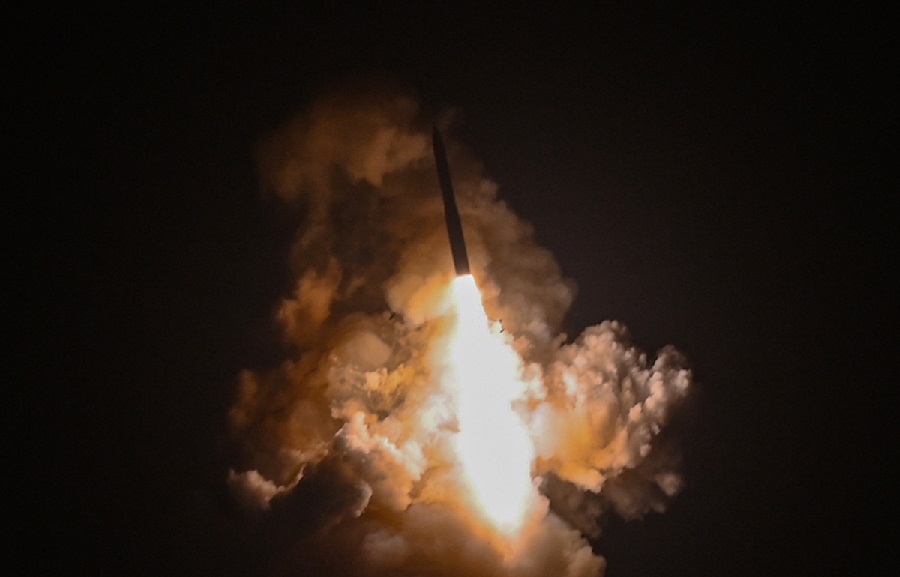
Britain has relied solely on submarine-launched Trident missiles armed with UK sovereign-designed warheads since withdrawing the WE177, its last air-launched nuclear weapon, in 1998. Trident remains the country’s single sovereign nuclear delivery system and the core of its strategic deterrent.
Four Vanguard-class ballistic-missile submarines currently carry the deterrent from HMNB Clyde. The Royal Navy has maintained the Continuous At Sea Deterrence since April 1969, providing the permanent operational foundation of Britain’s nuclear posture.
The Vanguard fleet will be replaced from the early 2030s by four Dreadnought-class submarines designed and built in the UK. More than 150 metres long and crewed by 130 sailors, the new boats will remain capable of launching Trident II D5 missiles.
The Dreadnought programme forms part of the government’s nuclear “triple-lock”. It commits Britain to building all four submarines at Barrow-in-Furness, maintaining uninterrupted deterrent patrols and delivering every future upgrade needed to sustain the capability.
The partnership with Washington also reinforces Britain’s role within NATO’s nuclear posture. The UK’s independent deterrent is assigned to the defence of the alliance and contributes alongside the strategic nuclear forces of the United States and France.
Britain is expanding that contribution by purchasing at least 12 F-35A dual-capable aircraft for NATO’s nuclear mission. The jets will be based at RAF Marham and flown by British pilots, restoring a nuclear role for the Royal Air Force for the first time since the UK retired its sovereign air-launched weapons after the Cold War.
During a crisis, the British-operated F-35As could carry U.S. nuclear weapons, which would remain under U.S. control. This NATO role will complement, but remain separate from, Britain’s sovereign submarine-based deterrent.
The UK and U.S. are also extending their strategic defence and industrial relationship through AUKUS, together with Australia. The partnership will deliver nuclear-powered but conventionally armed SSN-AUKUS attack submarines, improve information and technology sharing and generate multi-billion-pound investment in British industry.
The Ministry of Defence placed these partnerships within a deteriorating global security environment in which other nuclear-armed states are modernising, enlarging and diversifying their arsenals. Britain is responding with the most extensive renewal of its defence nuclear capabilities and supporting industrial base since the end of the Cold War.