DIU said Russia has begun deploying the Geran-4 as a countermeasure to the effectiveness of Ukrainian interceptor drones. The agency said the system reflects a new stage in Russia’s development of jet-powered strike UAVs.
Initial test launches were carried out from the Primorsk droneport in Russia’s Oryol region and from the territory of the former Donetsk Airport. DIU said those launches took place during final preparations for mass production, which were completed by January 2026.
The agency said Russia began combat deployment of the Geran-4 in May 2026 to strike Ukrainian territory. The drone follows earlier Russian jet-powered UAV designs, including the Geran-3.
For previous jet-powered UAVs, including the Geran-3, Russia used the airframe of the gasoline-powered Geran-2. DIU said that experience showed the structure was not strong enough for high-speed flight and was even less suitable for manoeuvring under high G-loads.
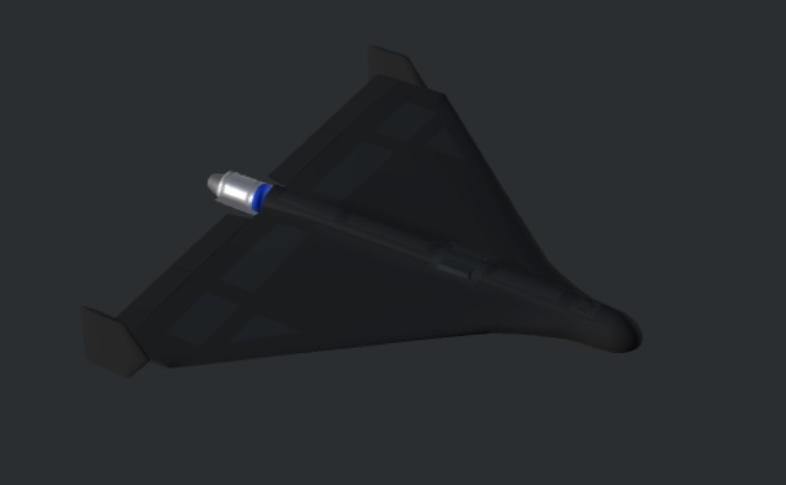
The Geran-4 uses a new airframe with improved aerodynamic efficiency and reinforced structural strength. The drone is also fitted with a turbojet engine with increased thrust.
Its wings are permanently integrated into the centre wing section. To reduce air resistance, the number of technological hatches on the fuselage has been minimised.
DIU said two types of turbojet engines have been observed on Geran-4 drones. These are the discontinued Chinese Telefly LX-WP-160 engine, with 160 kg or 1,600 N of thrust, and the Chinese Telefly TF-TJ2000A engine, with 200 kgf or 1,960 N of thrust, previously seen on the Geran-5 UAV.
The new airframe allows the Geran-4 to manoeuvre actively at speeds of 300 to 400 km/h. Its reinforced structure allows it to withstand significant G-loads.
DIU said the drone can reach speeds of up to 500 km/h and fly at altitudes of up to 5,000 metres. It can carry either a 50 kg OFZBCH-50/TBBCH-50M high-explosive fragmentation or thermobaric warhead, or an enlarged 90 kg TBBCH-90 thermobaric warhead.
The agency said the Geran-4 has a range of up to 450 km. Its dimensions remain unchanged from the standard format, with a length of 3.5 metres and a wingspan of 3 metres.
The onboard control system and electronic component base are identical to those used in previous known UAVs manufactured by JSC SEZ PPT Alabuga. DIU said this indicates continuity in Russia’s production approach for these systems.
DIU said exposing the new Russian-Iranian developments is intended to underline the role of foreign technologies in Russia’s drone programme. “Terror knows no borders, and stability can only be restored to the world by depriving russia of access to the technologies the aggressor uses to wage its criminal war,” the agency said.
Source: Defence Intelligence of Ukraine.