The Corsair, operated by the Navy’s Task Force 59 under the 5th Fleet, recovered the crew of an AH-64 Apache after the helicopter went down in regional waters. It carried the soldiers to another location, where they were hoisted into a helicopter.
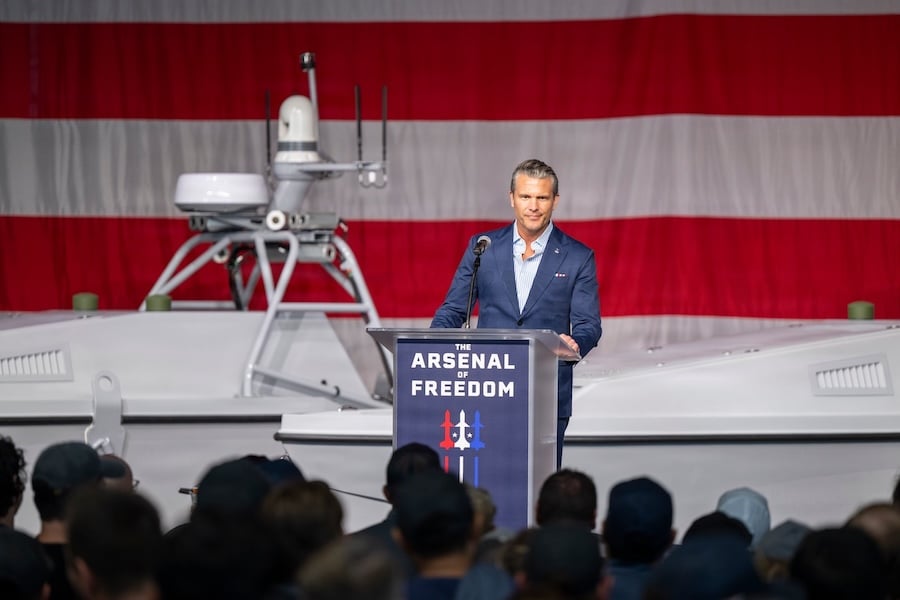
“Those pilots are alive today because of the incredible innovation under this very roof,” Hegseth told employees during a visit to Saronic’s headquarters in Austin, Texas. “You should be … incredibly proud of that feat.”
Hegseth said the Corsair later took part in an operation against the Bandar Abbas Naval Base. He described the mission as the first operational use of sea drones in U.S. military combat operations.
“In July, U.S. Central Command employed the Corsair to strike a submarine and ship maintenance facility at Bandar Abbas Naval Base,” he said. “The operation degraded Iran’s ability to continue attacking commercial shipping and marked the first operational employment of sea drones in U.S. military combat operations.”
The two missions support the Department of War’s effort to expand the role of autonomous systems beyond aerial drones. Hegseth said vessels such as the Corsair would become a central part of future U.S. naval power.
Saronic manufactures three autonomous vessels: the Corsair, the 52-foot Mirage and the 180-foot Marauder. Hegseth said the company had delivered more than 300 Corsairs while accelerating work on its larger platforms.
The visit was part of Hegseth’s Arsenal of Freedom tour, which is focused on increasing domestic weapons production and opening military procurement to nontraditional suppliers. The department is also pursuing its Drone Dominance initiative to expand the use of autonomous systems across different operating domains.
“The Department of War … has been kicking the door wide open for commercial disruptors, nontraditional innovators and venture-backed builders; we are actively creating the next generation of defense primes, firms like Saronic,” Hegseth said. “Our Arsenal of Freedom tour showcases how modern deterrence requires commercial speed.”
The department has consolidated its innovation organizations under Emil Michael, undersecretary of war for research and engineering and chief technology officer. Acquisition reforms led by Undersecretary of War Mike Duffey are intended to give program executives greater authority and expand the use of multiyear procurement contracts.
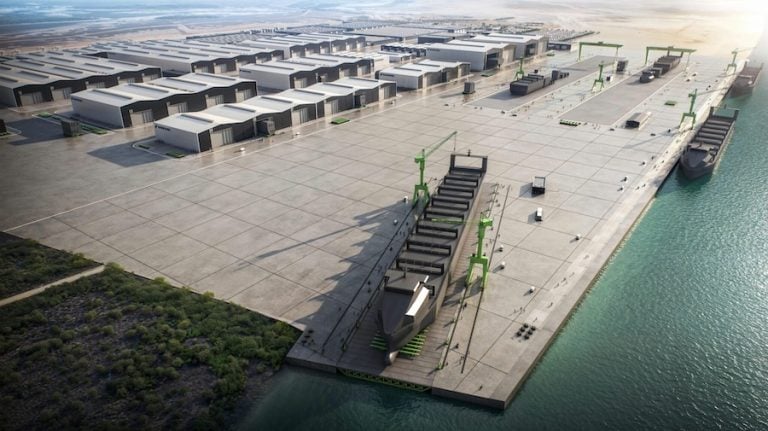
Hegseth also linked autonomous-vessel production to a wider effort to revive U.S. shipbuilding capacity. Saronic is investing in new facilities in Texas and Louisiana while expanding its workforce.
“At the Port of Brownsville [in Texas], Port Alpha … delivers a $3 billion investment, up to 10,000 high-paying jobs, over $160 billion in regional impact for Cameron County, [Texas,] and 150,000 … gross tons of new shipbuilding capacity,” Hegseth said. “This industrial muscle here will double domestic shipbuilding and ensure absolute dominance.”
Saronic is investing about $300 million in Louisiana, including at the Gulf Craft shipyard in Franklin. Hegseth said the project would create more than 1,500 maritime jobs.
“All the strategies from the Pentagon are meaningless without the people on this floor: the technicians, the machinists, the fabricators and the engineers,” Hegseth said. “Every platform you weld, wire and assemble gives our warfighters the decisive edge to win and return home. Never forget that direct line from your hands to the success of our warfighters.”
Hegseth called on the company to expand output as the military increases its reliance on autonomous naval systems. “Today I say to you: build faster, scale larger and deliver more,” he said. “We need you like never before, because when America is unleashed, we win.”
Source: U.S. Department of War.