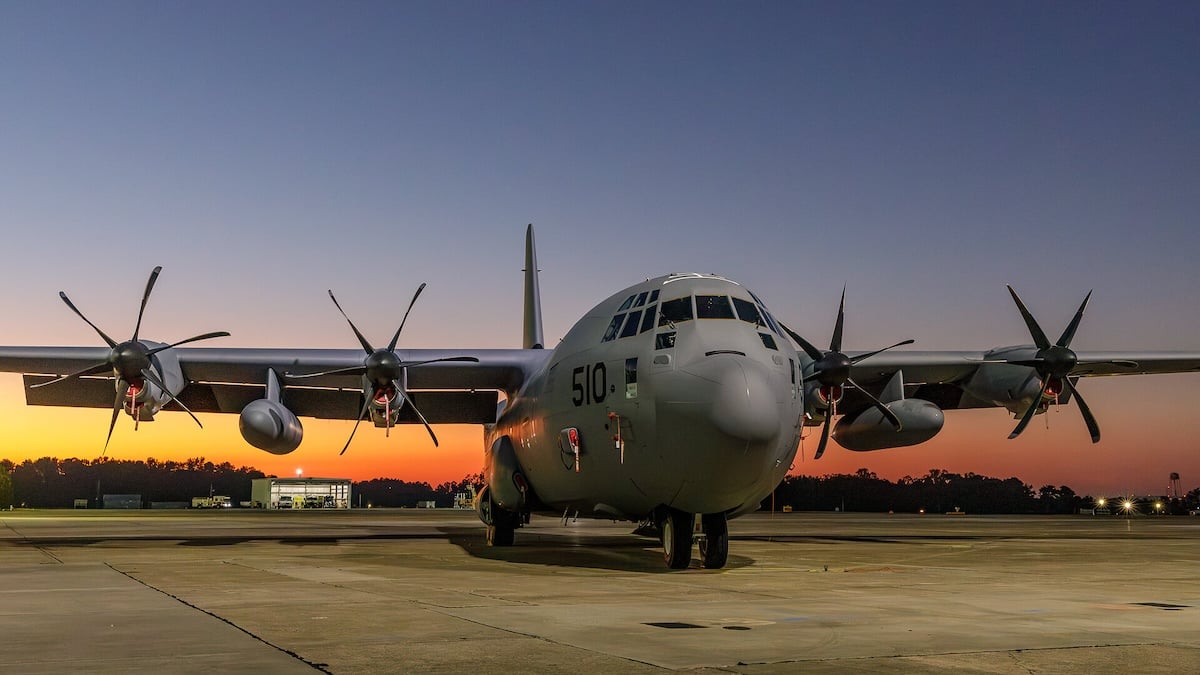
Lockheed Martin delivered the aircraft on Oct. 15 at its production facility in Marietta, Georgia. The newly built airframe is part of an initial procurement of three aircraft acquired by the Navy in September 2024.
The E-130J will support secure, survivable communications between the president, the secretary of defense and U.S. Strategic Command. Its mission includes maintaining the link between national leadership and the Navy’s ballistic missile submarine fleet during a crisis or conflict.
“Today’s delivery from the historic Marietta line represents far more than a new airframe; it marks the foundation of our future strategic deterrence posture,” said Capt. Roger Davis, the Navy’s Airborne Strategic Command, Control, and Communications program manager. “Through our close partnership with Lockheed Martin and our industry team, we are ensuring our nation maintains an unshakeable communications lifeline to our ballistic missile submarine fleet.”
Northrop Grumman will lead the conversion as prime contractor and mission systems integrator. Collins Aerospace will provide the Very Low Frequency communications systems.
Following post-delivery processing, the aircraft will undergo mission-system modification, ground testing and developmental flight testing. These stages will precede operational fielding.
The program is part of the modernization of the U.S. Nuclear Command, Control, and Communications architecture, known as NC3. The Navy said the new platform would provide greater endurance, capacity and operational reach.
The extended C-130J-30 supplies the four-engine airframe for the mission. Lockheed Martin cited its range, payload capacity and fuel efficiency among the features supporting the Navy’s requirements.
“This delivery marks a historic milestone for the U.S. Navy, Lockheed Martin, and the nation’s strategic communications network,” said Trish Pagan, vice president of Lockheed Martin’s Air Mobility & Maritime Missions. “The C-130J-30 Super Hercules continues to evolve and adapt to the needs of our customers, carrying the proven reliability of its lineage while transforming into a new, strategic mission set.”
Strategic Communications Wing 1, based at Tinker Air Force Base, Oklahoma, will operate and maintain the modernized TACAMO fleet. The wing currently operates E-6B Mercury aircraft around the clock, receiving, verifying and retransmitting emergency action messages.
“Strategic deterrence is only as credible as our ability to communicate, and that mission rests in the hands of SCW-1’s world-class Sailors,” said Capt. David Gardner, the wing’s commodore. “The E-130J will provide our Sailors unmatched capability and next generation survivable and reliable communications, ensuring our team continues to be the unbreakable link between the President and strategic nuclear forces.”
Selected sailors visited Marietta before the ceremony for simulator flights, production line tours and program briefings. The wing also currently operates U.S. Strategic Command’s airborne command post mission, known as Looking Glass.
The Phoenix II name recalls the Navy’s use of the EC-130Q Hercules for TACAMO during the Cold War. The E-130J restores the Hercules family’s connection to that mission with updated avionics, communications and survivability features.