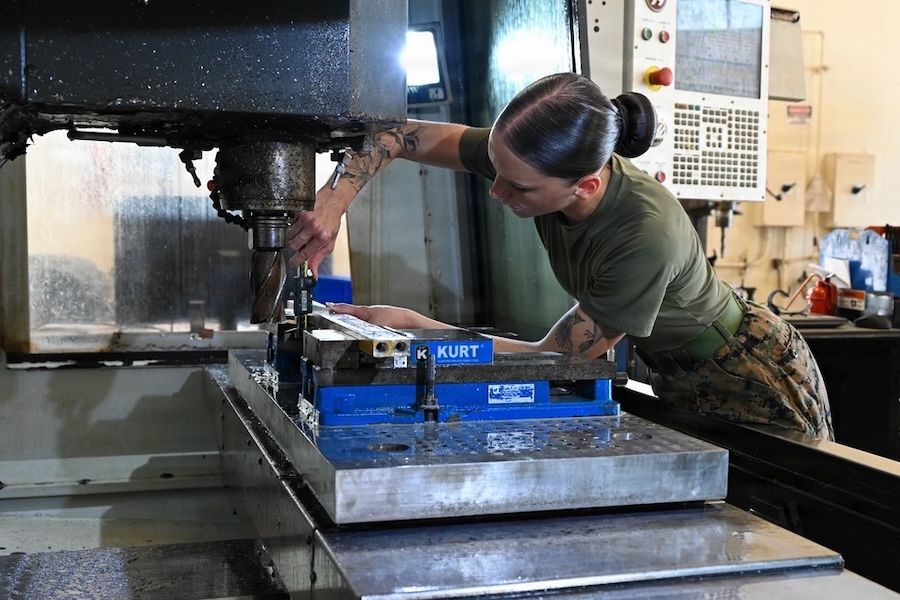
Marines with Intermediate Repair Company, 3rd Maintenance Battalion, 3rd Marine Logistics Group, worked with government laboratories, engineers and industry partners from June 1 to July 1. The initiative, called Resilient Advanced Manufacturing For Contested Environments, or RAMFORCE, was hosted by the Office of the Under Secretary of Defense for Research and Engineering.
The experiments brought together the U.S. Army Development Command Armaments Center, Naval Surface Warfare Center Carderock, Oak Ridge National Laboratory’s Manufacturing Demonstration Facility, RGBSI Aerospace and Defense, nScrypt and Haas Automation. The work tested how expeditionary forces could repair, replace and manufacture critical equipment at the point of need.
“As a force we are only largely, and generally, aware of additive and subtractive manufacturing techniques and products, but RAMFORCE is not just about advanced manufacturing — it is about integration,” said Maj. Daniel Krake, company commander of Intermediate Repair Company. “On their own, each event is fascinating; combined across commodities they are game changing.”
One experiment used nScrypt’s nRugged system to repair damaged circuit boards in austere environments. Marines learned to diagnose faults, replace failed components, restore electrical pathways and recreate damaged circuitry from existing schematics.
“This piece of machinery takes up-close photos of circuit cards,” said Staff Sgt. Ryan Grillo, an Intermediate Repair Company Marine and experiment team lead. “It pieces them together into a high-definition photo of the circuit card. Once the circuit card is mounted and catalogued, the nRugged has multiple tool heads capable of replacing components, repairing electrical runs and creating entirely new electrical runs.”
Another team tested cold spray repair, which restores worn metal components by accelerating powdered metal onto damaged surfaces without melting the base material. The method is intended to extend equipment life and reduce waiting time for replacement parts already needed in theater.
“The cold spray machine shoots metal powder at subsonic speeds,” said Staff Sgt. Huffman, experiment team lead with Intermediate Repair Company. “In this case, we are using aluminum and nickel at 375 degrees Celsius. It builds up a layer of new metal higher than the original surface before it’s machined back to specification.”
Oak Ridge National Laboratory’s Manufacturing Demonstration Facility led hybrid manufacturing demonstrations. The process digitally scans damaged components, recreates them as three-dimensional models, then uses additive and subtractive manufacturing in one machine.
Research scientist Blane Fillingim said the aim is to make the process usable by service members with limited specialized experience. The hybrid team also produced components for another RAMFORCE experiment, showing how separate manufacturing tools could support one another during operations.
The Digital Manufacturing Exchange, or DMX, tested secure sharing of technical data packages between military units and industry partners. RGBSI Aerospace and Defense’s Zach Brandon described the system as a secure digital backbone for controlling access to technical information and approved production requests.
For distributed operations, data movement may matter as much as moving physical parts. “We have advanced manufacturing and information systems experts working alongside our Marines to establish new methods for exchanging technical data packages between industry and deployed service members,” Krake said.
“We have them working with both electronics and mechanical maintenance Marines to reduce equipment downtime, allowing them to collaborate to create flexible, deployable maritime platforms,” he said. The goal is an integrated sustainment system for units operating from dispersed locations across the First Island Chain.
The most visible demonstration was Manufacturing Attritable Systems at Scale, or MASS. Marines and Naval Surface Warfare Center Carderock engineers built a 7-meter foam raiding craft designed for production in theater using deployable equipment and commercially available materials.
“The shape of the hull is not the goal,” said Marissa Stecko, a mechanical engineer supporting logistics and manufacturing operations with NSWCC. “It’s the manufacturing that we’re trying to showcase.”
The team used a computer numerical control router, a large-format polymer 3D printer and a spray foam and coating system. The process is intended to let Marines fabricate platforms closer to the mission instead of shipping complete systems over long distances.
“The goal would be to modify this manufacturing process to make any platform that would be usable for the Marine Corps, the Navy or whoever needs it,” Stecko said. “We do the design work on the back end and push those digital files to the end-user so they can manufacture the platform where it’s needed.”
Stecko said an earlier 5-meter prototype hull was made in about 16 working hours using about $11,000 in materials. “We have reason to believe that, once fully scaled, we could manufacture a 5-meter platform every four hours with a team of 12, and a 7-meter platform every six hours,” she said.
“We’re still in the prototyping phase, but there’s a tremendous amount of potential,” Stecko said. The 7-meter craft later received a protective polyurea coating, a 300-horsepower Mercury outboard engine and a Fort Robotics autonomous control system.
The craft was tested June 29 at White Beach Naval Facility. It completed manned and unmanned operations, including autonomous waypoint navigation, during a demonstration observed by senior U.S. and Japanese military leaders.
RAMFORCE also tested Print on the Move, which assessed whether polymer 3D printers could produce parts while being carried on tactical vehicles and watercraft. “We are engineers training them on how to operate these printers,” said Dr. Cindy Waters, senior science and technology manager with NSWCC.
“We specialize in advanced manufacturing, and we’re here to support the Marines with whatever they need throughout the week,” Waters said. She said the printers were selected after testing for reliability, repeatability and ruggedness.
“The printers range from being quite expensive to really affordable,” Waters said. “A lot of research went into selecting these printers to ensure they are reliable, repeatable and rugged.”
During the final demonstration, one printer continued making a component while being transported to White Beach and then aboard the foam raiding craft. The result showed how Marines could manufacture mission-critical parts while moving between operating sites.
Senior leaders at the demonstration included Lt. Gen. Roger Turner, commanding general of III Marine Expeditionary Force; Japan Ground Self-Defense Force Lt. Gen. Seiji Toriumi, commanding general of Western Army; and Brig. Gen. Christopher Haar, commanding general of 3rd MLG. Naval Surface Warfare Center Carderock personnel also showed the Configurable Budget Autonomous Swarming Submersible, a low-cost unmanned underwater vehicle for seafloor data collection.
“The power of additive manufacturing is that it is adaptable to whatever that next threat is,” said Col. Howard Marotto II, a capabilities analyst with the Secretary of the Navy’s Direct Reporting Offices. “I see the future, I see the potential, and it would greatly help if we can drive more funding for these new programs of record.”
Krake said the impact of RAMFORCE will continue after Valiant Shield 26. “We will be trained, manned and equipped to deploy these field-ready technologies inside the First Island Chain to improve lethality and operational readiness,” he said.
For the Marine Corps, the tests point to a sustainment model built around repair, digital data and local production near the edge of the battlefield. The effort suggests that future logistics may depend not only on shipping parts across oceans, but on giving Marines the tools to manufacture and repair them where the mission requires.