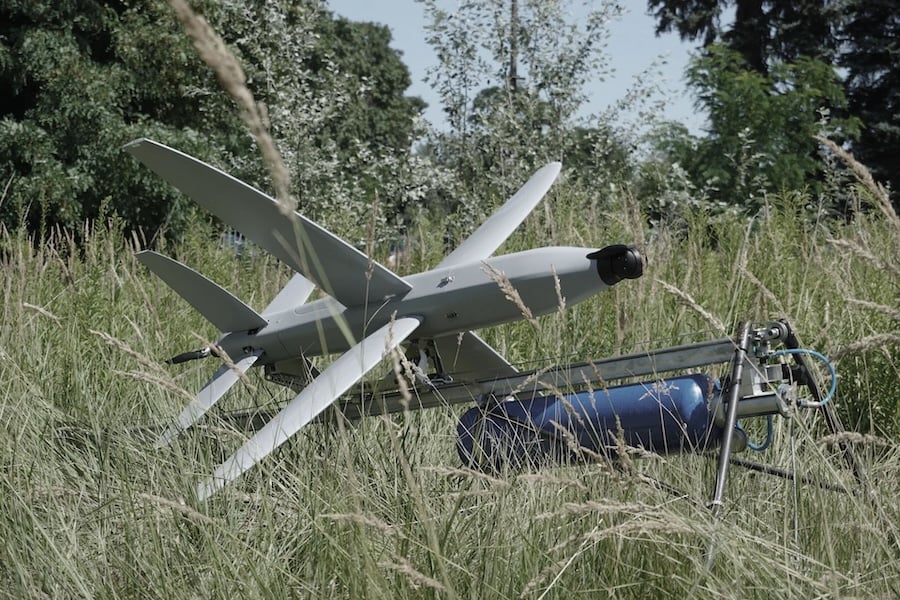
TASACK made its public debut on 8 September at the MSPO 2026 defence exhibition in Kielce, Poland. FlyFocus expects the system to reach production readiness in the first quarter of 2027.
The electrically powered aircraft weighs 15 kilograms and carries a payload of up to 5 kilograms. It can remain airborne for as long as 90 minutes and reach speeds of up to 300 kilometres per hour.
A stabilised daylight or infrared gimbal allows operators to identify and track targets before engagement. TASACK can execute attack profiles ranging from flat approaches to near-vertical top attacks, with stated visual targeting accuracy of one metre CEP50.
FlyFocus has paired those capabilities with a point-and-click control interface that reduces the piloting skills required to operate the weapon. The approach is designed to simplify target engagement compared with conventional first-person-view systems, which require extensive operator training.
“TASACK has been designed around what we believe matters most for this class of system: precision, simplicity and the ability to manufacture at meaningful scale,” said Igor Skawiński, chief executive and co-founder of FlyFocus. “Modern militaries need sophisticated capabilities, but they also need systems that can be produced affordably, deployed quickly and adapted as battlefield conditions change.”
“Our objective with TASACK is to bring those requirements together in one platform,” Skawiński said. FlyFocus has simplified the system’s internal and external architecture to reduce manufacturing costs and support faster assembly, maintenance and upgrades.
Most TASACK components, including its targeting gimbal, are manufactured in Poland. FlyFocus said this supports its strategy of retaining control over key drone technologies and building systems around secure supply chains aligned with NATO requirements.
The munition has an 80-kilometre datalink range and combines enhanced satellite navigation with an inertial navigation system during midcourse flight. Radio navigation can also be added as an option for missions requiring an alternative navigation method.
Its modular airframe can accommodate different warheads based on operational requirements. FlyFocus said operators can prepare the system for launch in about five to seven minutes.
TASACK shares a ground-control interface with FlyFocus’s Polaris, CableGuard and Striker platforms. The common operating environment is intended to limit the additional training required when personnel move between the company’s different unmanned systems.